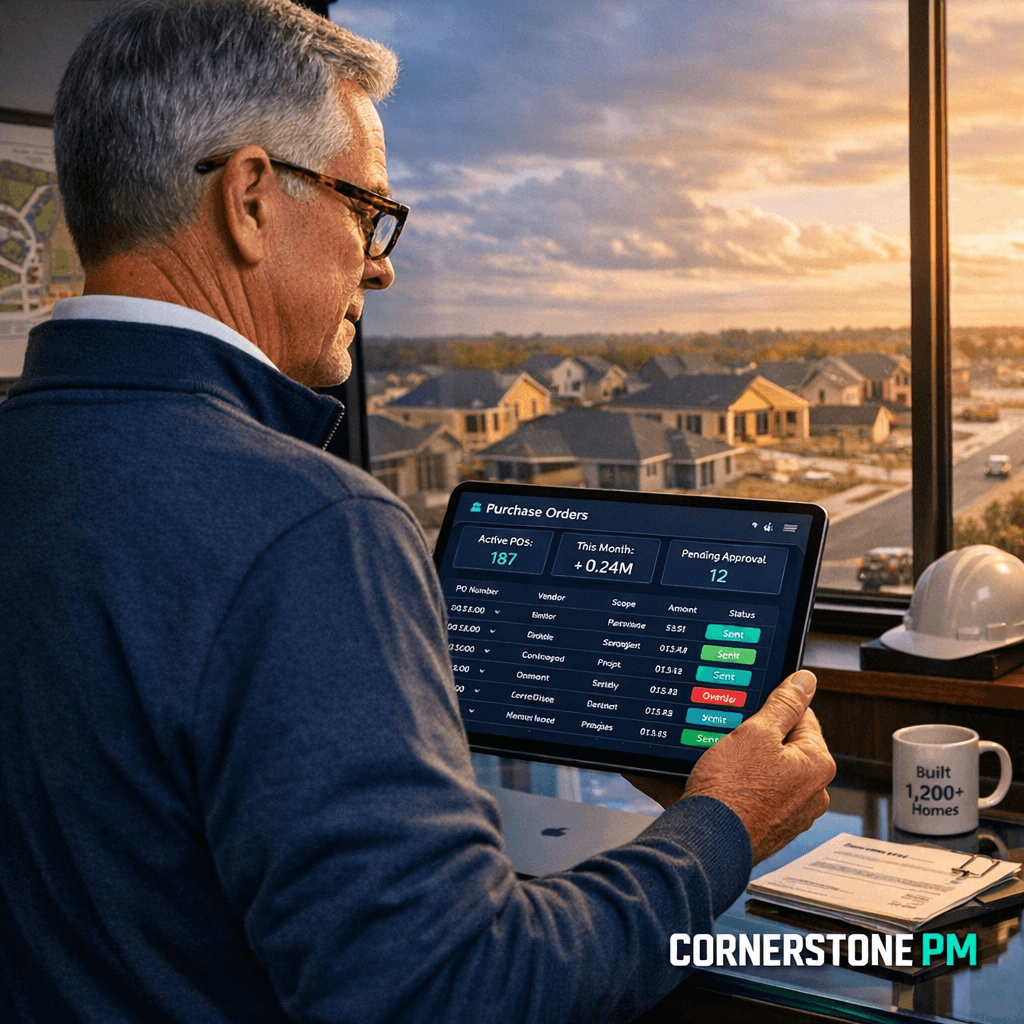
Construction Purchase Order Software for Home Builders (2026 Guide)
Searches for “construction purchase order software” have surged dramatically in the past year. That's not a coincidence. It's home builders and contractors finally getting fed up with managing POs in Excel — and looking for something better.
The good news: the market has caught up. There are now purpose-built tools that handle the full purchasing cycle — from vendor bids to PO generation to budget tracking. The challenge is knowing what to actually look for, and which tools are built for residential home builders versus generic commercial contractors.
Why spreadsheets break down for construction POs
Most small-to-mid builders start with Excel. A PO log, a budget tab, a vendor contact list. It works fine when you're building 3 homes a year. It falls apart at 10+.
The problems are predictable: files get out of sync, bid statuses aren't updated, budget variances aren't caught until the home closes, and nobody knows which subs actually respond to bids versus the ones who ghost you. You end up managing the spreadsheet instead of the project.
The more fundamental problem is that spreadsheets don't connect to anything. Your PO log doesn't talk to your schedule. Your budget doesn't update when a change order comes in. Your vendor list doesn't know which subs performed well last quarter.
What construction PO software should actually do
Not all PO software is created equal. Generic small-business tools like QuickBooks or FreshBooks can generate purchase orders — but they don't understand construction workflows, don't connect to your schedule, and don't handle the bid process.
Here's what purpose-built construction PO software should handle:
- —†’Vendor directory with performance data (bid response rates, win rates, insurance status)
- —†’Bid request generation and portal-based collection
- —†’Normalized bid comparison across multiple vendors
- —†’PO generation from approved bids, linked to specific homes and scopes
- —†’Real-time budget vs. actual tracking across all active homes
- —†’Change order management with budget impact visibility
- —†’Parts/materials catalog with current pricing
- —†’Export to Excel or PDF for field teams and subs who need offline access
If a tool is missing two or more of those, you're going to end up filling the gaps with — you guessed it — spreadsheets.
The AI shift: plain English purchasing
The biggest change in 2025–2026 is AI integration that actually does something useful. Not a chatbot that answers generic questions about construction — an agent that reads and writes your real data.
With Foreman AI (Cornerstone PM™'s built-in AI agent), a builder can type:
You say:
“Create a bid request for all Plumbing vendors for Bayshore Commons and send portal invites”
🪖 Foreman does:
Bid request drafted with community specs, scope details, plan references, and submission deadline. Portal invites sent to 8 active plumbing vendors in your system. Responses trackable in your dashboard.
Or: “Flag any homes where actual costs are more than 10% over budget.” Foreman scans every active home and returns a variance report in seconds — something that would take a PM an hour to pull manually.
Or: “Scrape Home Depot for GE Profile refrigerators and add them to our parts catalog.” Foreman fetches current pricing, creates the parts, and links them to your design center options.
This is genuinely new. Traditional construction PO software requires you to do the data entry. AI-driven tools can handle the routine work — leaving you to manage the exceptions.
What to look for in 2026
When evaluating construction purchase order software, the questions that matter most for a residential home builder:
- —†’Is it built for residential, or adapted from commercial/contractor software?
- —†’Does it connect purchasing to your schedule and budget?
- —†’Can you track vendor performance over time, not just per-project?
- —†’Does AI actually read and write your data, or just answer generic questions?
- —†’What does implementation actually look like — days or months?
- —†’Is pricing per-seat (penalizes team growth) or flat?
On the last point: most enterprise construction software charges per user. That's a problem for builders who want their PMs, admins, and field leads all in the system. Cornerstone PM™ is flat-rate — up to 30 users on Starter/Builder/Pro and 60 on Pro+.
The bottom line
If you're still managing POs in Excel, the cost isn't just the time your PM spends on data entry. It's the budget overruns you don't catch until closeout, the bids that fall through the cracks, and the vendor relationships you can't measure.
Modern construction PO software — especially AI-integrated platforms — has made this a solvable problem for builders of any size. The question is whether you want to keep paying for it in margin erosion, or invest in tooling that pays for itself on the first budget variance it catches.
Cornerstone PM™ is in beta right now. The purchasing module, Foreman AI, and the full platform are free for 2 years for early adopters. No credit card required.
Try Cornerstone PM™ free
Beta access is open now. 2 years free for early adopters. Includes the full purchasing module and Foreman AI.
Request Beta Access