Homebuilding AI: How AI is Changing Residential Construction in 2026
Finance got AI first. Legal, healthcare, and software development followed quickly. Homebuilding — one of the most operationally complex businesses in the American economy — has been one of the last industries to see purpose-built AI. That's changing fast in 2026.
The reason homebuilding was late isn't that builders weren't interested in AI. It's that the industry has specialized workflows that generic AI tools were never trained to handle. Lot tracking, floorplan pricing, pre-sale pipelines, design center options, spec level management, subcontractor coordination across multiple homes — none of that maps cleanly onto generic project management or commercial construction software.
But the technology has caught up. Here's where homebuilding AI is making the biggest impact right now — and where it's heading.
Where AI is making the biggest impact in homebuilding
Scheduling and subcontractor management
This is the highest-pain area for most home builders — and the area where AI is delivering the most immediate value. Managing 15 homes across 8 trades via text messages and spreadsheets creates constant bottlenecks, cascade delays, and accountability gaps.
Homebuilding AI is changing this by giving builders visibility across all active homes simultaneously. Instead of reviewing each home's status manually, a builder can ask their AI agent to flag all homes that haven't had a status update in 14 days, surface which subcontractors have the worst on-time records, and identify bottlenecks at the community level — all in one conversation.
Procurement and vendor management
Homebuilding procurement is paper-intensive and relationship-driven. Bid requests, scope of work documents, bid comparisons, vendor scorecards — these are all tasks that take significant time and produce inconsistent results when done manually.
AI is making procurement faster and more rigorous. Purpose-built homebuilding AI can draft a bid invitation for every vendor in your system for a specific scope, generate a normalized bid comparison when responses come in, and maintain performance records over time — tracking response rates, win rates, and insurance compliance automatically.
Sales pipeline and design center
The pre-sale workflow in homebuilding is unique and complex. Buyers are making hundreds of decisions — design center selections, option upgrades, spec level choices — over weeks or months. Managing that pipeline and ensuring buyers don't fall behind on decisions before their cutoff dates is an operational challenge that generic CRM tools handle poorly.
Homebuilding AI that understands design center workflows can flag buyers with incomplete selections before the cutoff, analyze which options are selling best and at the highest margin, and generate design center summary documents for lenders and title companies automatically.
Budget and cost management
Most builders don't find out they lost margin until the home closes. By then, it's too late. AI that can analyze committed costs vs. budgeted amounts across all active homes — and flag variances before they become losses — changes the economics of homebuilding in a fundamental way.
AI built for homebuilding vs AI adapted to homebuilding
This distinction is the most important thing to understand when evaluating homebuilding AI tools in 2026.
AI adapted to homebuilding is a generic tool — a project management platform, a CRM, an AI assistant — that has been configured or prompted to work with construction data. It's better than nothing, but it has fundamental limitations: it doesn't understand residential construction vocabulary, it requires you to explain your workflows repeatedly, and it can't take action in your actual systems.
AI built for homebuilding is different. It was designed around residential construction workflows from the start. It understands what a spec level is. It knows the difference between a design center option class and a parts catalog item. It can create a Scope of Work document that actually sounds like it was written by someone who knows construction — because its skill set was built by people who do.
The practical difference: AI adapted to homebuilding helps you write better emails about construction. AI built for homebuilding runs your operation.
Real examples of AI in homebuilding workflows
“Which homes in Bayside Preserve are behind on the framing schedule?”
4 homes flagged. Lot 7 is 9 days behind — foundation inspection ran long. Lots 12, 14, and 16 waiting on lumber delivery ETA.
“Generate a bid request for all Plumbing vendors for the Coastal Ridge community”
Bid request drafted with scope, specs, timeline, and site access details. 8 plumbing vendors in system. Portal invites sent.
“Show me design center revenue by category across all active buyers”
Kitchen upgrades: $847k total, 82% selection rate. Flooring: $412k, 76%. Lighting: $198k, 61%. Chef's kitchen package: highest margin at 34%.
“Flag any homes where we're more than 8% over budget on any scope”
2 homes flagged. Lot 22 at Pinecrest: concrete 11% over. Lot 8 at Bayside: HVAC 9% over. Change order documentation attached.
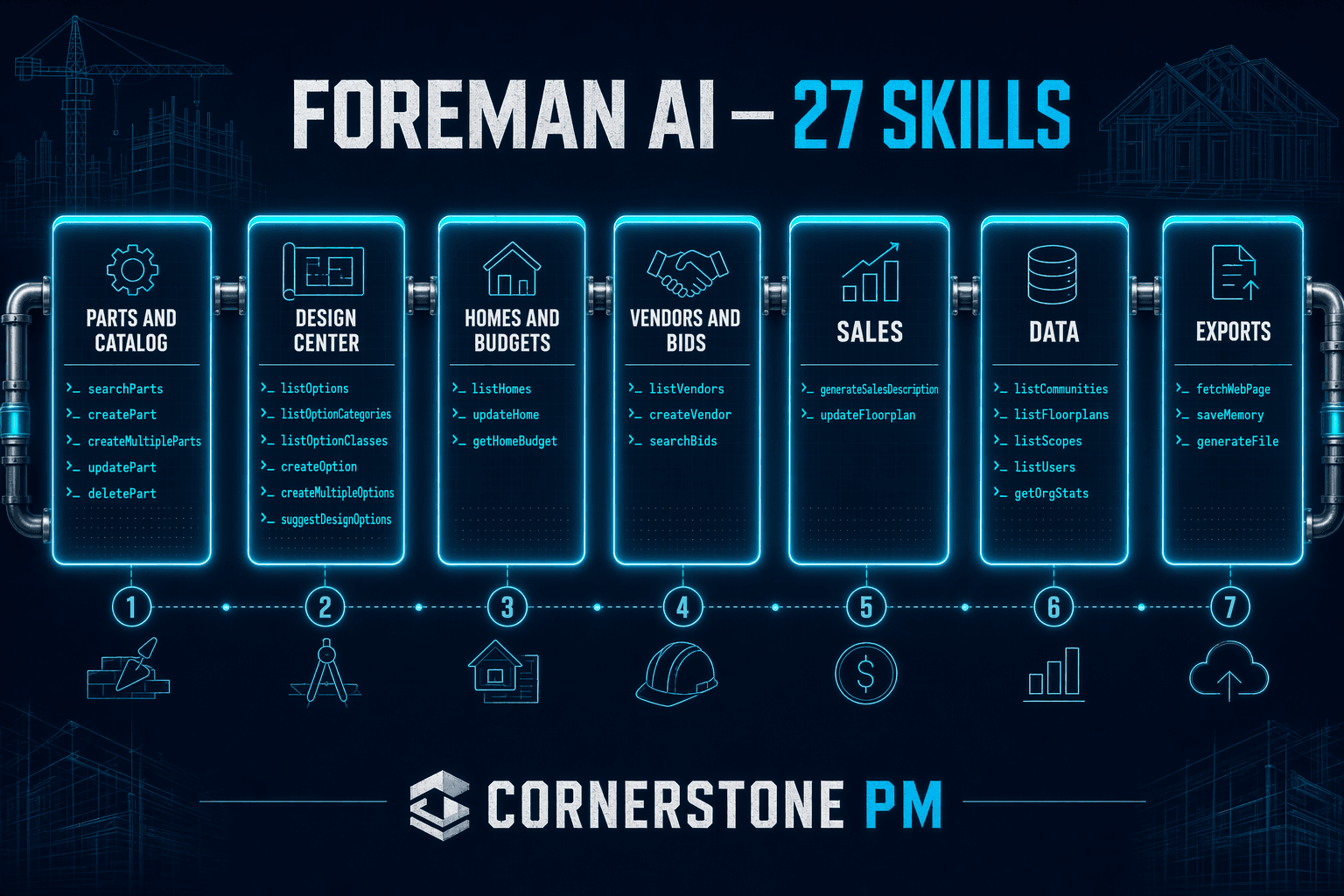
These examples are from Cornerstone PM™'s Foreman AI — a 396+ skill AI agent purpose-built for home builders that reads and writes real construction data in plain English.
What's coming — homebuilding AI in the next 18 months
The first wave of homebuilding AI has focused on making existing workflows faster. The next wave will start to change the workflows themselves.
Permit tracking automation. Permit delays are the silent schedule killer for home builders. AI that can monitor permit status, flag approaching deadlines, and surface inspection requirements automatically — without someone manually checking the city portal every week — is coming.
Subcontractor scoring and recommendation.As AI systems accumulate performance data — on-time rates, bid win rates, quality complaint history — they'll start making recommendations on which sub to call first for a new bid cycle. Not based on relationship or habit, but on data.
Buyer communication AI. Buyers call twice a week for status updates. AI that can answer “How is my home coming along?” with a real, accurate, up-to-date response — without a team member spending 20 minutes on a phone call — is a natural extension of homebuilding AI that has access to real construction data.
Predictive margin analysis.AI that doesn't just report current variances but predicts which homes are on a trajectory toward margin loss — based on early patterns in committed costs, change orders, and schedule delays — is the next frontier.
The bottom line
Homebuilding AI is no longer a future concept. It's here, it's working, and the builders who adopt it first are going to have a meaningful operational advantage. The difference between AI adapted to homebuilding and AI built for homebuilding is the difference between a tool that helps you write about your operation and a tool that actually runs it.
Cornerstone PM™ is building that second kind of tool. Foreman AI — 396+ purpose-built skills, real data access, persistent memory. Beta is open now.
See homebuilding AI in action
Cornerstone PM™'s beta is open. Foreman AI is included in the Pro plan. 2 years free for early adopters.
Request Beta Access