1099 Season Prep: How to Confirm Vendor W-9s Are Current Before January
Confirm every vendor who invoiced you this year has a current W-9 on file, with a business name and taxpayer ID that actually match, before the calendar flips to January — not after your accountant asks for the first one that's missing. Doing it against the same vendor records you already use for scheduling and purchasing turns a December fire drill into a five-minute review.
Every production builder has had some version of this: it's the first week of January, the bookkeeper is trying to close out 1099s, and three vendors who did real work this year never submitted a W-9. Now someone's emailing a sub who already moved on to another job, trying to get a tax ID before the filing deadline. None of that has to happen in January if the check happens in November instead.
What does a year-end W-9 review actually check?
Four things, and all four matter more than just "do we have a form on file."
What the review checks
Every active vendor has a W-9 on file
Not just the vendors you paid this month — every subcontractor and supplier who invoiced you at any point this calendar year
Business name matches the taxpayer ID
A mismatched name and EIN/SSN is the single most common reason a 1099 gets kicked back or flagged
Entity type is recorded, not assumed
Sole proprietor, single-member LLC, S-corp, and partnership vendors get handled differently at filing time
No vendor is missing a W-9 and still active
A vendor who worked a lot last month without a W-9 on file is a problem to fix now, not in January
Why collect the W-9 at onboarding instead of at year-end?
The cheapest time to get a W-9 is before the first invoice, when a new vendor is already filling out a registration form and handing over insurance and scope-of-work documents anyway. The most expensive time is in January, when the vendor who did the work has no urgency to respond to a form request and the clock on your filing deadline is already running.
Cornerstone collects W-9s the same way it collects COIs and signed scope of work — through the vendor registration form, before the vendor is ever assigned to a lot. That's the same onboarding flow covered in our piece on vendor insurance and COI tracking — the tax form is one more document in the same intake, not a separate process someone has to remember to run in December.
Why does the business name/tax ID match matter so much?
A lot of subcontractors operate under a trade name that doesn't match their legal entity name — "Mike's Framing" invoicing under a different LLC name entirely. When the W-9 on file doesn't match the name the 1099 gets filed under, it's one of the most common triggers for an IRS notice. Catching that mismatch when the form comes in, not when the filing bounces back, is the whole point of reviewing the record instead of just checking a box that says a document exists.
How does entity type change what happens at filing time?
A vendor's W-9 should also record whether they're a sole proprietor, a partnership, an LLC (and how that LLC is taxed), or a corporation. Unincorporated vendors paid $600 or more over the year generally need a 1099-NEC; most corporations don't. Recording that distinction when the form is collected means nobody has to guess at filing time — the accountant preparing 1099s can filter by entity type instead of calling every vendor to ask what they are.
How does this connect to the rest of the vendor record?
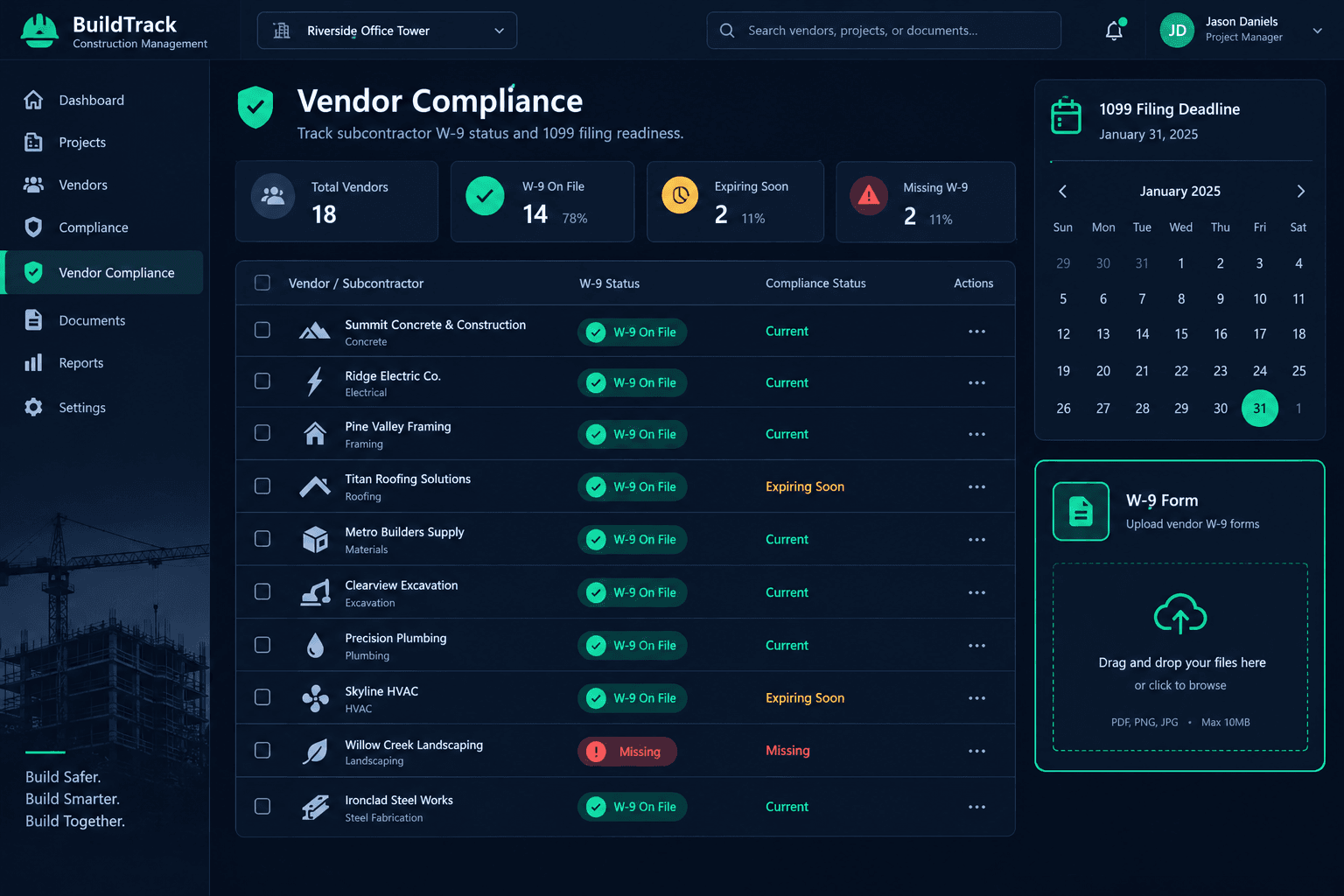
The W-9 status lives on the same vendor profile that drives bid awards and purchase orders in Cornerstone — not a separate accounting system that only gets opened in January. That means a quick filter on the vendor list for "no W-9 on file" surfaces the exact subcontractors who need a follow-up, without cross-referencing a spreadsheet against every invoice paid this year.
Cornerstone tracks the document and the data on it. It doesn't calculate 1099 thresholds, generate the forms, or file them — that part still runs through your accountant or payroll/tax software. What it removes is the part where nobody can say, with confidence, which vendors are missing a form until the filing deadline is already close.
When should this review actually happen?
November or early December, not the first week of January. A vendor who gets a request for a missing W-9 six weeks before the filing deadline will usually respond. The same request sent three days before the deadline competes with every other builder doing the same scramble at the same time — and a vendor who's already moved on to other jobs has little reason to prioritize it.
Run the review against the same vendor records you use the rest of the year, and the list of who's missing a form is a filter, not a research project.
Know which vendors are missing a W-9 before your accountant asks.
Cornerstone tracks W-9 status on the same vendor record used for insurance compliance, bid awards, and purchase orders — so year-end 1099 prep starts with a filter, not a spreadsheet audit.
Request Early Access