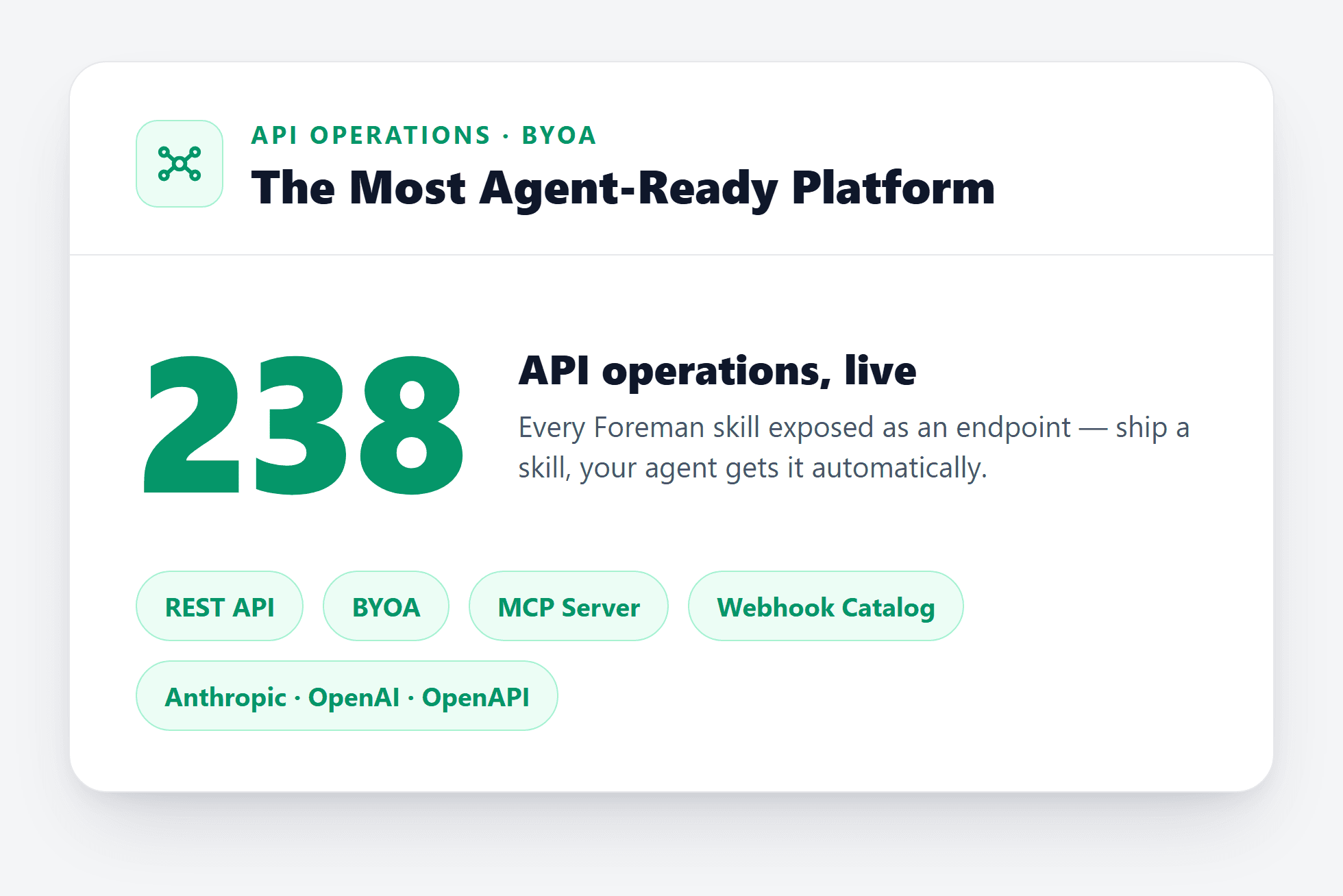
238 API Operations: The Most Agent-Ready Construction Platform
Cornerstone PM now exposes 238 total API operations to external AI agents. Not 238 marketing bullet points \u2014 238 discrete things an agent like Claude, ChatGPT, or an n8n workflow can actually read, write, or trigger inside your construction platform. That is the number that matters when you are deciding whether your software can be automated, or just claims it can.
For the full picture of how Cornerstone PM compares to other tools, start with the home builder project management software guide. This post zooms in on one thing: the API surface, what the 238 number is built from, and why it is the most honest way to measure how agent-ready a platform really is.
Why “operations,” not just “endpoints”?
Most software brags about endpoint counts. An endpoint is a route \u2014 a URL your code can hit. Cornerstone PM ships 150+ of them across 84 dedicated RESTful routes plus a generic execute route. But the endpoint count undersells what an agent can do, because one of those routes \u2014 the execute endpoint \u2014 fans out across the entire Foreman AI skill catalog.
An operation is a discrete action an agent can invoke. When we count every dedicated route plus every skill reachable through execute plus every webhook an agent can subscribe to, we get 238. That is the real answer to the question a developer or an AI agent actually asks: what can I do here?
What the 238 operations are built from
Hand-built endpoints for the core nouns of a home builder: homes, tasks, vendors, bids, purchase orders, payments, options, parts catalog, design center, and more.
A single execute route that runs any Foreman skill by name. Every skill Foreman can run internally, your agent can run externally — and the list grows automatically.
Typed, HMAC-signed outbound events with delivery logs and retry. The push half of the automation layer — your stack reacts the moment something happens in the field.
Anthropic tool format, OpenAI function calling, and OpenAPI 3.1. Point Claude, ChatGPT, or any OpenAPI client at the same surface without translation.
Stack those together and you get a platform an external agent can fully operate: read a home record, generate a purchase order, send a bid request to five vendors, update a design-center option, fire an SMS to a sub, and listen for the webhook that confirms the sub acknowledged \u2014 all without a human clicking through the app.
One execute route, the whole Foreman catalog
The architectural trick is the generic execute endpoint. Instead of hand-writing a separate route for every action, Cornerstone PM exposes the full Foreman AI skill catalog through one execute surface. Your agent fetches the skill schemas from GET /api/ext/skills and runs any skill by name through POST /api/ext/execute.
This is the BYOA \u2014 Bring Your Own AI Agent \u2014 philosophy in one design decision: every endpoint maps to a Foreman skill, so when Foreman ships a new skill, your agent inherits it automatically with zero configuration. The 238 number is a snapshot. It only goes up.
Three schema formats means no translation layer
An API surface is only agent-ready if agents can read it. Cornerstone PM publishes its schemas in 3 formats \u2014 Anthropic tool format, OpenAI function calling, and OpenAPI 3.1. That means you point Claude, ChatGPT, or any OpenAPI-aware tool (n8n, Make, Postman, custom code) at the same surface and it just works. No hand-written wrappers, no format conversion, no glue code to maintain.
How this compares to the rest of the market
| Capability | Most platforms | Cornerstone PM™ |
|---|---|---|
| Agent-invokable operations | A handful | 238 total |
| Generic execute over full skill catalog | ||
| Multi-format tool schemas | Usually none | 3 formats |
| Typed, signed webhook catalog | 1–3 generic | 37+ named |
| Built-in MCP server | ||
| New capabilities auto-exposed |
JobTread, Buildertrend, and CoConstruct tell you “webhooks exist” and maybe “an API is available.” Cornerstone PM ships the full skill catalog as endpoints, in three agent-readable formats, with a webhook catalog on the outbound side and an MCP server for no-code connection. The difference is the difference between a checkbox and a platform your AI agent can actually run.
Where to find it
The REST API, BYOA layer, webhooks, and MCP server are exclusive to the Pro+ plan ($599/mo). There is no add-on path on lower tiers \u2014 Pro+ includes the entire 238-operation surface, plus 396+ Foreman skills, 60 user seats, and priority support. Full developer documentation lives at app.cornerstonepm.ai/developers.
Give your AI agent the same toolbox Foreman uses.
238 API operations, 3 schema formats, 37+ webhooks, and an MCP server \u2014 the most agent-ready platform built for production home builders.
Request Early Access →