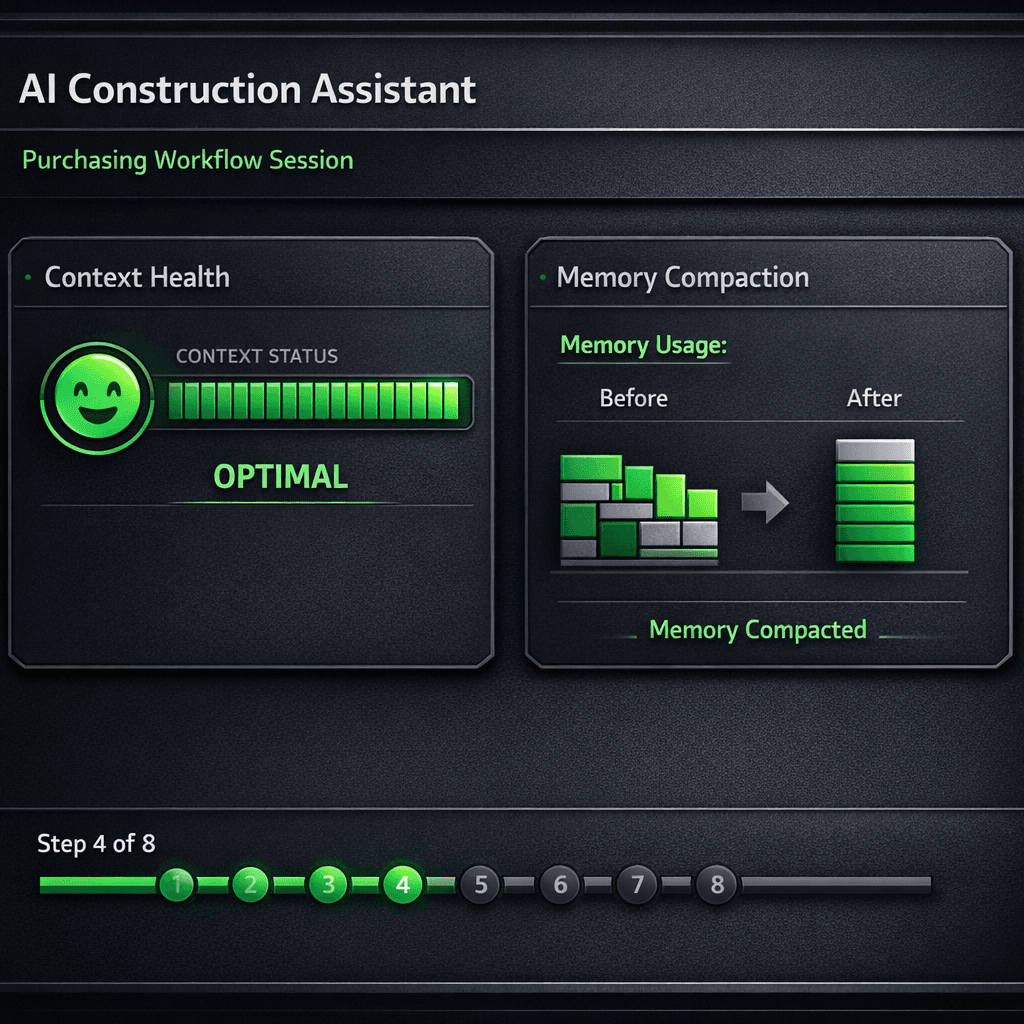
Why Most Construction AI Forgets—and How Foreman Doesn’t
Most construction AI tools hit a context wall mid-task and start forgetting what you said five minutes ago—or crash entirely. Foreman AI uses built-in memory compaction to keep working through 200+ option cleanups, full catalog imports, and multi-step purchasing workflows without losing the thread. It’s the only construction AI that doesn’t forget.
If you’ve tried using a general-purpose AI tool for a complex construction workflow, you’ve run into the wall. You’re deep into a purchasing session —cleaning up 200+ option SKUs, bulk-reassigning vendor bids across three communities, or running a full cost-budget reconciliation—and then the AI either stops making sense, starts contradicting what it said earlier, or flat-out crashes the session. You lose your place and have to start over.
That wall is a context limit. Every AI model has a maximum amount of conversation it can hold in working memory at once. Most tools do nothing when they approach that limit. They just degrade silently until they fail. For a construction AI agent doing real work, that is an unacceptable failure mode.
What happens when construction AI hits the context wall
The context wall doesn’t announce itself. Here’s how it typically plays out in a construction workflow:
- You ask Foreman to clean up option names across the Magnolia plan. It handles the first 40 cleanly. By option 90, it starts repeating SKUs it already fixed. By option 150, it has forgotten what naming convention you set at the start of the session.
- You run a bid import workflow: download all pending bids, map them to scope items, flag pricing outliers, update the master cost budget. Halfway through, the AI loses track of which scopes have already been confirmed and starts re-asking questions you already answered.
- You’re doing a line-by-line design center audit with a sales agent and the AI can no longer recall the spec-level decisions made in the first half of the call.
This isn’t theoretical. It’s the daily experience of builders trying to use generic AI tools for long-session construction workflows.
How Foreman’s memory compaction solves it
Foreman AI is built on purpose-built construction AI infrastructure, not a thin wrapper around a general chat model. One of the core architectural decisions is automatic memory compaction: as a session grows, Foreman intelligently summarizes older parts of the conversation, compresses them into structured memory, and carries forward only the relevant context.
The result is an agent that survives the long haul. Foreman keeps working through:
- 200+ option cleanups in a single session
- Full catalog imports with multi-step validation loops
- Long purchasing workflows that span bid collection, comparison, and award
- Design center audits with dozens of spec-level decisions to remember
- Multi-community schedule analysis sessions
No other construction AI does this. Competing tools either crash at scale or just silently degrade. Foreman keeps the thread.
The context health meter: know before you hit the wall
Even with memory compaction, context is a finite resource. Foreman surfaces a real-time context health meter—a green/yellow/red indicator that tells you exactly where you are in the session’s capacity before you hit any degradation.
Green — full capacity
The session is fresh or well-compacted. Foreman has full access to everything discussed and is operating at peak accuracy. This is where you want to be for high-stakes workflows: awarding vendor bids, finalizing option pricing, generating purchase orders.
Yellow — compaction active
The session is long. Memory compaction is running and keeping Foreman productive, but this is a good time to wrap up exploratory work and move to decision-making while the context is still tight.
Red — start fresh
The session has hit its useful limit. Foreman tells you directly: start a new session to maintain full accuracy. You won’t get surprised mid-task by a silent quality drop.
The meter is not a warning you have to hunt for. It’s surfaced inline in the Foreman interface so that anyone using it—superintendent, sales agent, purchasing manager—can see the session health at a glance and make an informed decision about whether to continue or start fresh.
Per-user memory: Foreman knows who you are across sessions
Memory compaction solves the within-session problem. Per-user memory solves the across-session problem.
Most AI tools treat every new conversation as a blank slate. You have to re-explain your role, your preferred vendors, your naming conventions, and your workflows every single time. That’s not an agent—that’s a very fast search engine.
Foreman AI carries two memory layers:
- Per-user memory—your name, role, preferred vendors, communication style, and workflow preferences. Tell Foreman once that you always quote in “finished square footage” and it uses that vocabulary back in every future session. Tell it you hate lengthy responses and it stays concise.
- Company-wide memory—your vendor scorecards, recurring scope patterns, community-specific pricing defaults, and builder standards. Every user on your team benefits from the shared institutional knowledge Foreman has built up.
Concrete examples of per-user memory in action:
- A superintendent who always sources plumbing from Ferguson — Foreman defaults to Ferguson on PO drafts and flags any non-Ferguson bid as a deviation.
- A sales agent who quotes in finished square footage — Foreman uses that unit consistently and never asks which sqft basis to use.
- An owner who hates bullet-point dumps — Foreman keeps responses punchy and decision-focused.
Learn more about how Foreman’s per-user memory works in practice.
Why “construction AI” without memory isn’t a construction AI
The real work in construction is not a five-minute task. It’s a two-hour purchasing session that spans bid collection, comparison, scope clarification, award, and PO generation. It’s a full-day design center audit for a new plan launch. It’s a multi-week vendor re-bid cycle that runs in parallel with active builds.
An AI tool that forgets at minute 10 is not a workable co-pilot for any of those scenarios. It’s a toy. Foreman is built to match the actual tempo of construction work—long sessions, complex workflows, and the expectation that the agent remembers everything it learned yesterday.
The 396+ Foreman skills cover the full operational surface of a production home builder: bid comparison, SOW generation, vendor scorecards, purchase order management, budget analysis, and more. But skills without memory produce a different result every time. Memory is what turns a skill catalog into an agent that actually knows your business.
For a full overview of what Foreman can do and how it fits into the production builder workflow, the Foreman page covers the complete skill catalog, memory architecture, and plan availability. Foreman is available on Pro+ as part of the full home builder project management software platform.
Try the construction AI that doesn’t forget
Foreman AI runs 396+ purpose-built skills with persistent per-user memory, company-wide context, and built-in memory compaction for marathon sessions. Available on Pro+.
Request Early Access →