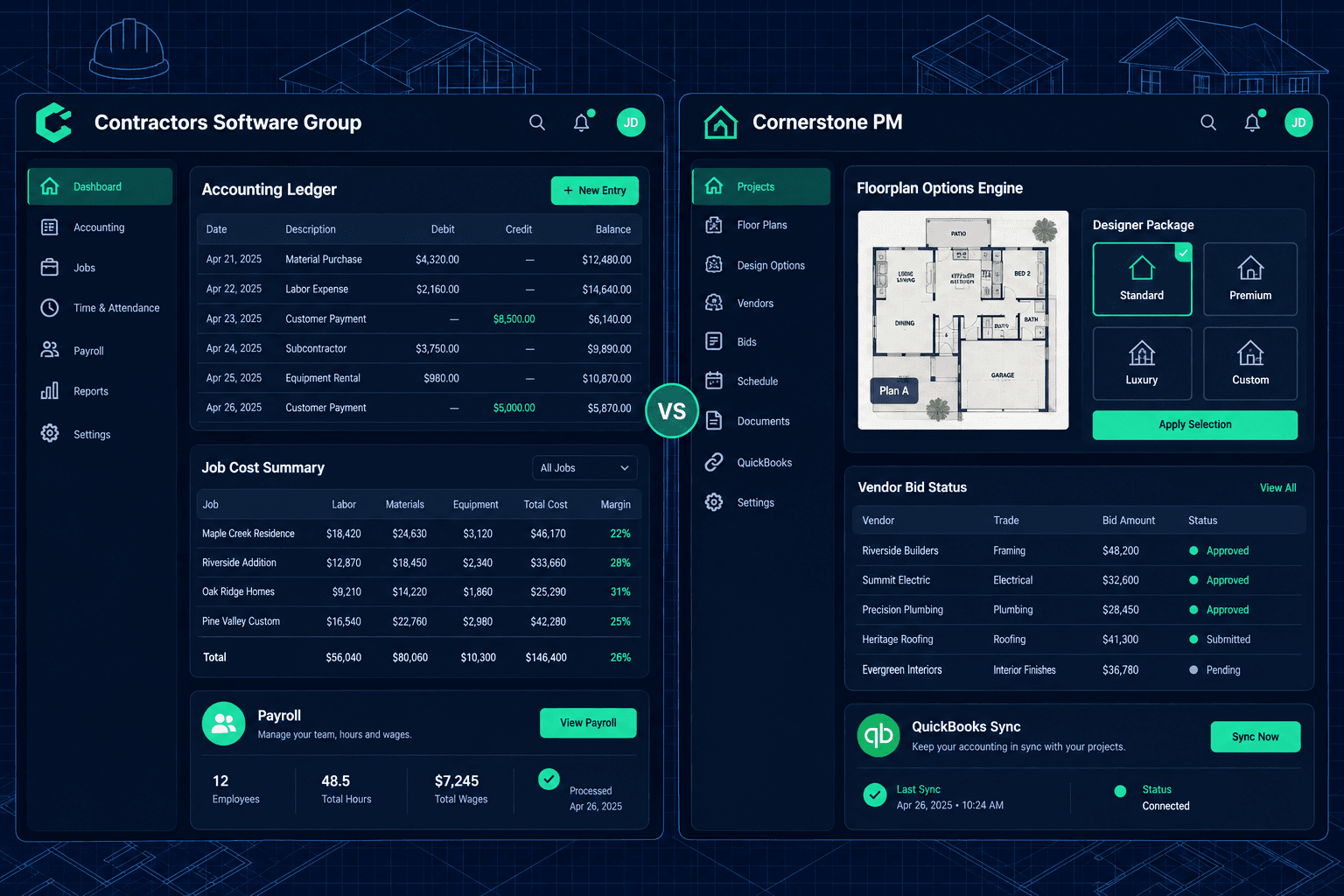
Contractors Software Group vs Cornerstone PM: Compare the Homebuilding Workflow
Contractors Software Group (CSG) already builds for home builders — this isn't a segment mismatch comparison. The real question is how each platform handles the same workflow: estimating a floorplan, awarding a vendor bid, tracking a buyer's options, and getting the numbers into your books.
CSG has served construction and home building businesses with a tiered product line — Simple, Plus, and Professional — built around native job cost accounting. Cornerstone PM approaches the same builder from a different data model: floorplans and per-plan options as the center of gravity, with accounting handled through an outbound sync rather than a built-in ledger. Both are legitimate ways to run a home building business. This post walks through where they actually diverge, using CSG's published home builder software page as the source for its current positioning. Product editions and pricing change, so confirm current specifics directly with CSG before deciding.
What does CSG offer home builders?
CSG's home builder software page positions the platform as a way to "run your entire home building business in one integrated platform," built around five connected pieces:
- Home Builder CRM — sales, marketing, buyer management, and customer service/warranty tracking.
- Estimating / takeoff — tools to build budgets, purchase orders, work orders, and subcontracts from a takeoff.
- Scheduling and project management — coordinating vendors and employees across active jobs.
- Job Cost Accounting — a native accounting module covering job costing, billing, bookkeeping, payroll, and financial reporting.
- CSG Central (web portal) and a mobile time card app — sharing job information with vendors and clients, and capturing field time that flows into the accounting module.
CSG's own materials emphasize this as a "fully integrated system" giving "real-time visibility across operations and finance" — and the native accounting module is a real differentiator worth taking seriously if accounting-under-one-roof is a priority for your team.
Where does Cornerstone PM's workflow diverge?
Walk the same scenario — a floorplan, a community, a vendor award, and a buyer's option list — through Cornerstone and the shape of the work changes:
- Floorplan-level pricing, not job-by-job: Cornerstone prices a floorplan's options once and reuses that pricing across every home of that plan, in every community it sells in. CSG's estimating module builds budgets, purchase orders, and subcontracts from a takeoff — we don't have published detail on whether CSG reuses plan-level pricing the same way across repeats, so builders evaluating that specific behavior should confirm it directly with CSG.
- Designer Packages and exclusion groups: Cornerstone's design center groups curated options into 64 Designer Packages that auto-lock a category when a buyer picks one, and exclusion groups let a buyer pick one flooring or countertop option before the category marks complete. CSG's CRM module covers buyer management and warranty tracking; its published materials don't detail a comparable package-and- exclusion-group selections model.
- Auto-quantity scope items: A scope item like frame labor tied to total square footage reprices automatically across every floorplan and structural option when the rate changes. This is a specific data-model choice in Cornerstone's purchasing module, not a feature CSG's published materials describe.
- Vendor pricing flows from accepted bids: Cornerstone prices scope items only from accepted vendor pricing — a line with no accepted bid shows as needing pricing rather than carrying a placeholder cost. CSG's estimating and job cost accounting modules are described as integrated, but we don't have published detail on how unpriced scope lines display before a vendor award in CSG specifically.
- Accounting approach: CSG runs native job cost accounting — job costing, billing, bookkeeping, and payroll inside the same platform. Cornerstone carries purchasing and budget data through its own system, then syncs it outbound to QuickBooks Online, with manual review for payment approval rather than native payroll or bookkeeping. If your team wants accounting and construction management under one roof with no outbound sync step, CSG's native module is the stronger fit on that specific point.
Feature comparison: CSG vs Cornerstone PM™
This table reflects publicly described capabilities as of this writing. "Partial" means the capability exists in some form but with a different model or scope than the comparison implies — confirm specifics with each vendor before deciding.
| Feature | CSG | Cornerstone PM™ |
|---|---|---|
| Estimating / takeoff tools | ||
| Vendor bid requests and awards | ||
| Buyer CRM and sales pipeline | ||
| Native job cost accounting (billing, payroll) | ||
| Outbound QuickBooks sync | ||
| Per-floorplan options pricing (plan-level, reused) | ||
| Designer Packages (64 curated, auto-lock) | ||
| Design center exclusion groups (pick one) | ||
| Auto-quantity scope items (sqft-linked) | ||
| Multi-community lot / model hierarchy | Partial | |
| AI material takeoff from PDF | ||
| Foreman AI (396+ skills, persistent memory) | ||
| Mobile time card app | ||
| REST API + BYOA (Pro+) | ||
| Web/client portal for vendors and buyers |
What does Cornerstone PM add on top of the shared workflow?
Beyond the accounting and design-center divergence, Cornerstone PM bundles AI agents and an integration layer that CSG's published materials don't describe an equivalent for:
- Blueprint AI — parses a floor plan PDF and extracts 130+ material scopes in under 60 seconds.
- Foreman AI — 396+ skills across purchasing, vendor management, scheduling, and budget analysis, with persistent per-user memory. Meet Foreman →
- REST API and BYOA— on Pro+, 150+ endpoints and a generic execute surface so any of Foreman's skills can be called from an external tool.
CSG's differentiator in the same comparison is the mobile time card app feeding directly into native payroll — a workflow Cornerstone doesn't replicate, since payroll sits outside its scope.
Who should use each platform?
Consider CSG if you want…
- Native job cost accounting — billing, bookkeeping, and payroll in one system
- Field time tracking that flows directly into payroll
- A tiered product line you can scale into as needs grow
Consider Cornerstone PM™ if you want…
- Floorplan-level pricing reused across plan repeats and communities
- A buyer design center with Designer Packages and exclusion groups
- AI agents (Foreman, Blueprint) built into the platform, not bolted on
- QuickBooks as your accounting system of record, with Cornerstone feeding it
Both platforms are built for home builders, and the honest comparison comes down to where you want the center of gravity: a native accounting ledger with CSG, or a floorplan-and-options engine with Cornerstone feeding QuickBooks. For the fuller category picture, see the home builder project management software overview.
See the floorplan-and-options model in action
Cornerstone PM prices every floorplan once, reuses it across every community, and feeds accepted vendor pricing straight into your budget and QuickBooks.
Request Early Access