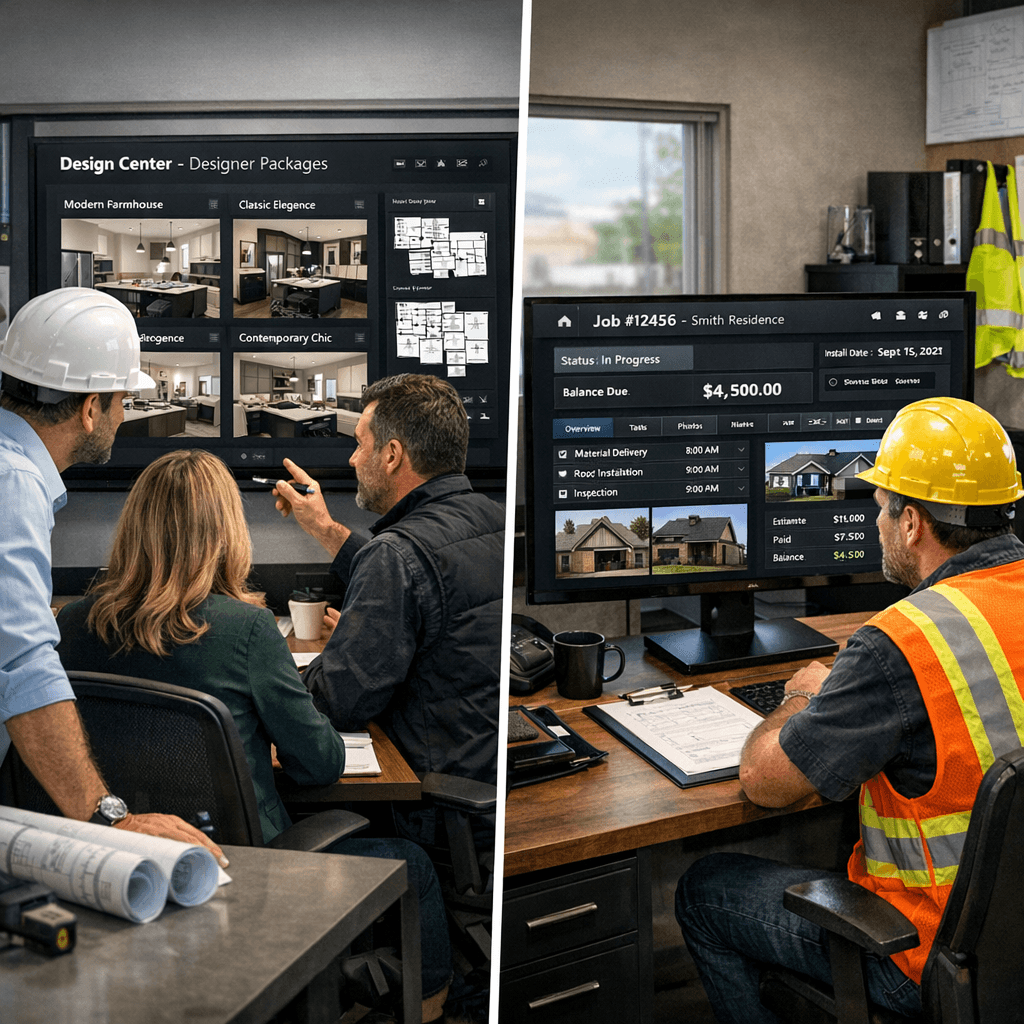
Cornerstone PM vs AccuLynx: Home Builder Software Compared
AccuLynx is the leading CRM for roofing contractors. Cornerstone PM™ is a production home builder platform with a full design center, AI agents, and multi-community workflows. They are not competing products — they serve completely different business models.
If you landed here from a “construction CRM” search and you're a whole-home builder, the short answer is: AccuLynx wasn't built for you. This post explains exactly why, and what a purpose-built production builder platform actually looks like. For the full platform overview, start at home builder project management software.
What is AccuLynx built for?
AccuLynx is the self-described “#1 Software for Roofing Contractors,” trusted by thousands of roofing businesses. Its product stack centers on:
- Lead management and follow-up automation for roofing sales teams
- Roofing proposals with integrated measurement data (EagleView, RoofSnap)
- Direct ordering from ABC Supply, QXO, and SRS Distribution — the major roofing material distributors
- Job board and production tracking for roofing crews
- Payment processing and financing options for homeowners
This is an excellent set of tools for what it is. A roofer closing 200 insurance claims a year genuinely benefits from EagleView integration and one-click ABC Supply ordering. That's a real, well-solved problem.
The issue is that AccuLynx has no concept of a floorplan. No concept of a model home. No lot management. No community-level vendor assignment. No design center. No options pricing engine. These aren't missing features — they're concepts that simply don't exist in the product's data model, because AccuLynx was built for a different type of contractor entirely.
What does a production home builder actually need?
A production builder doing 20–150 homes per year runs a fundamentally different operation than a roofing contractor. The workflows that create complexity are:
- Plan repeats: The same Magnolia floorplan sells 80 times across three communities. Options need to be priced once at the plan level and reused — not re-entered per job.
- Design center: Buyers select finishes, upgrades, and packages in a structured appointment. Those selections need to flow directly into purchasing without re-keying data.
- Multi-community vendor management: The framing crew in Community A might be different from Community B. Vendor assignments are community-aware, not global.
- AI material takeoff: Estimating 130+ material scopes from a CAD PDF for every new plan variant is time-consuming and error-prone without AI assistance.
- Bid workflows: Sending structured bid requests to 10 vendors, comparing results side-by-side, and awarding by community is core purchasing infrastructure.
AccuLynx addresses none of these. Cornerstone PM™ was built around them.
Feature comparison: AccuLynx vs Cornerstone PM™
| Feature | AccuLynx | Cornerstone PM™ |
|---|---|---|
| Floorplan / model home concept | ||
| Per-floorplan options pricing | ||
| Designer Packages (auto-lock category options) | ||
| Multi-community lot management | ||
| Community-assigned vendor wins | ||
| Buyer-facing design center portal | ||
| AI material takeoff from PDF | ||
| Foreman AI (396+ skills) | ||
| Side-by-side vendor bid comparison | ||
| Roofing job management | ||
| ABC Supply / QXO / SRS ordering integrations | ||
| Roofing measurement integrations | ||
| Single-trade lead & proposal CRM |
How does Cornerstone PM™’s design center work?
The design center is one of the highest-margin touchpoints in a home sale. A buyer choosing between a standard kitchen and a Designer Package upgrade is a revenue moment — and how you handle it determines whether you capture that revenue or leave it on the table.
Cornerstone PM™ ships 64 curated Designer Packages across 7 categories. When a buyer selects a package, all options in that category automatically lock to the package's selections — no manual per-option configuration required. If the buyer wants to customize further, they can unlock individual options from the package and make à la carte selections.
Options are priced at the floorplan level, not the job level. That means the Magnolia plan's kitchen options are set up once and reused across every Magnolia you sell in every community. When vendor pricing changes, you update it in one place.
This is a structural product difference from AccuLynx, Buildertrend, and most CRM tools that treat selections as job-level allowances. For a production builder selling the same plans repeatedly, the plan-level model is not a nice-to-have — it's the difference between a scalable design process and one that breaks down at 40 homes per year.
What about AI? Does AccuLynx have AI features?
AccuLynx has added some AI-assisted features for roofing estimating and proposal generation. These are useful for roofing contractors. They have no relevance to a whole-home builder's workflow.
Cornerstone PM™ ships five purpose-built AI agents:
- Blueprint AI — parses a floor plan PDF and extracts 130+ material scopes in under 60 seconds. See Blueprint AI →
- Foreman AI — an in-app agent with 396+ skills covering purchasing workflows, vendor management, schedule optimization, budget reports, and profitability analysis. Foreman reads AND writes data — it takes real actions, not just chat. Meet Foreman →
- Bid Import AI — auto-maps vendor bid spreadsheets to your scope items. No manual column matching.
- AI MLS Listing Generator — generates listing copy from your floorplan and options data.
- AI Support Agent — answers platform questions in context without leaving your workflow.
All five are bundled in the Pro+ plan. No add-on subscriptions, no API key configuration, no third-party accounts required.
Vendor bidding: a comparison worth noting
AccuLynx's vendor workflow is built around single-trade roofing material ordering from a small number of major distributors. This is appropriate for a roofer.
Cornerstone PM™'s purchasing module manages multi-trade bid requests across dozens of vendors:
- Send structured bid requests to multiple vendors per scope, with auto-generated Excel templates covering each vendor's relevant trade
- Vendors respond through a token-protected portal — no Cornerstone account required
- Side-by-side bid comparison when 2+ vendors submit
- Bids lock on acceptance — no last-minute edits from either side
- Community-assigned vendor wins: the awarded vendor for Community A can differ from Community B for the same scope
For more on how the purchasing workflow compares across platforms, see the Cornerstone PM purchasing overview.
So who should use AccuLynx, and who should use Cornerstone PM™?
Use AccuLynx if you are…
- A roofing or exterior contractor
- Managing insurance claim workflows
- Ordering from ABC Supply, QXO, or SRS
- Running single-trade residential or commercial jobs
Use Cornerstone PM™ if you are…
- A production home builder (5–200 homes/year)
- Selling the same floorplans across multiple communities
- Running a buyer-facing design center with upgrade packages
- Managing multi-trade vendor bids across communities
- Wanting AI agents bundled, not bolted on
The bottom line: AccuLynx is excellent for what it was designed to do. Whole-home production building is simply outside its scope by design. If you're evaluating home builder platforms, start with the full home builder software category comparison to find platforms purpose-built for your business model, then come back to evaluate specifics.
Built for production builders, not roofers
See how Cornerstone PM™ handles floorplans, Designer Packages, AI takeoff, and multi-community vendor management — the workflows AccuLynx was never designed for.
Request Early Access →