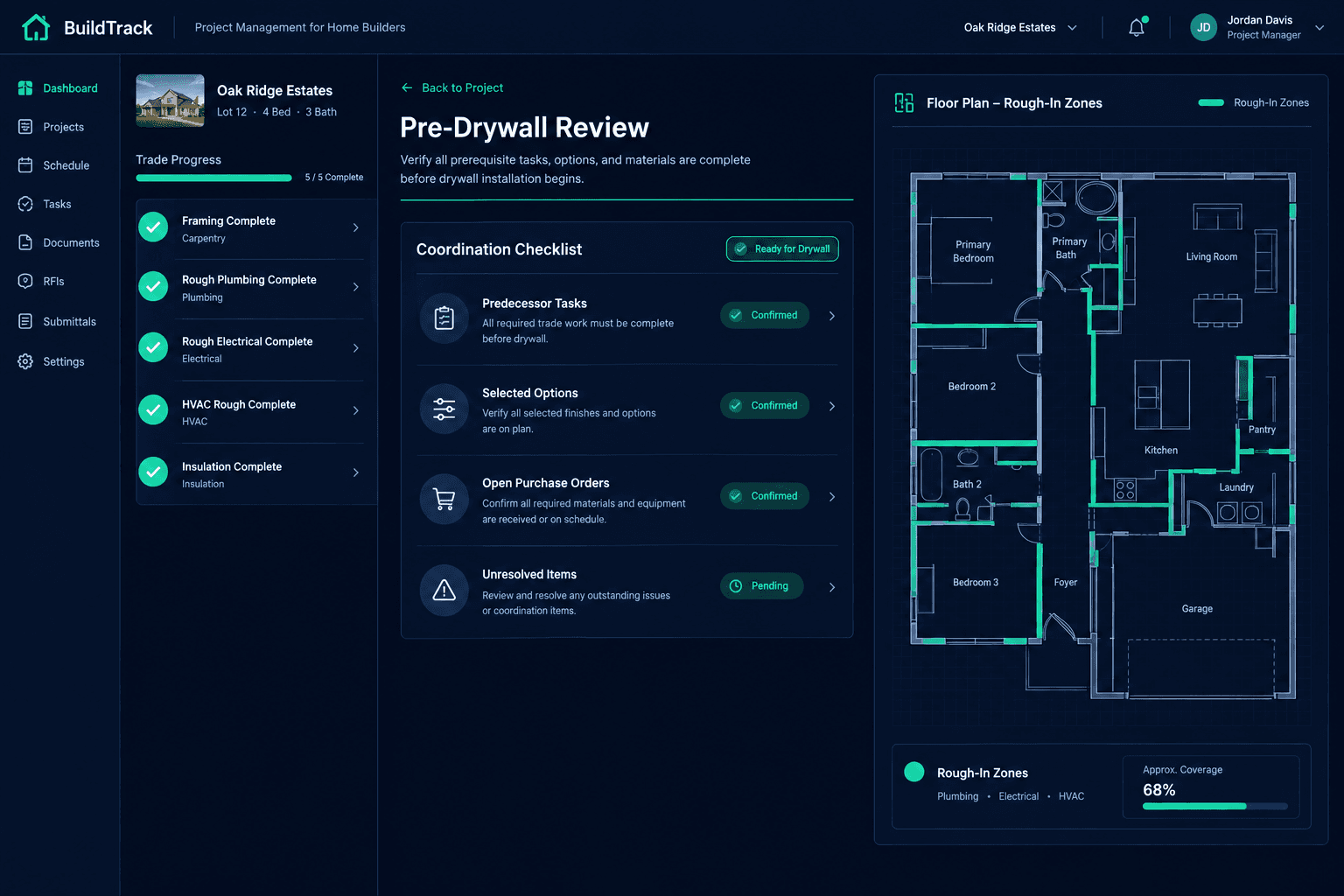
Before Drywall Starts: A Coordination Checklist for Home Builders
Drywall closes in every decision made on a home up to that point. Before releasing it, confirm predecessor trade work, selected options, outstanding materials, and unresolved decisions are actually resolved — not just marked complete in a schedule.
Drywall is the point of no return on a home. Once it's hung, every rough-in mistake — a missed outlet, a fixture in the wrong spot, a change order nobody built — turns into a cut-and-patch job instead of a five-minute fix. That makes the pre-drywall review one of the highest-leverage checks in the entire build, and one of the easiest to rush when a schedule is tight.
This isn't a code-compliance checklist and it isn't a substitute for a rough inspection. It's a coordination review: confirming that the work the schedule says happened, the options the buyer selected, and the materials purchasing ordered are all actually in the walls before the superintendent signs off on drywall.
What belongs in a pre-drywall coordination review?
A useful review has to cover more than a single trade. It pulls together four things that normally live in different parts of the build: the schedule's predecessor tasks, the buyer's selections, open purchasing items, and anything still unresolved that someone is waiting on an answer for.
What the review checks
Predecessor trade work
Framing, rough plumbing, rough electrical, HVAC rough, insulation — each confirmed complete in the schedule
Selected options affecting rough-in
Relocated fixtures, added lighting, structural changes — confirmed built, not just recorded
Outstanding materials
Open purchase orders tied to this home with rough-in materials not yet delivered
Required inspections
Rough inspections scheduled or passed before drywall is released
Unresolved decisions
Open change orders, unconfirmed selections, pending buyer questions — each with a named owner
Field confirmation
A person walks the home and confirms status in person before the task is cleared
Why selections need their own check, separate from the schedule?
A schedule can show framing, rough plumbing, and rough electrical all marked complete and still miss the point: did the rough-in actually reflect what the buyer selected? A relocated vanity light, an added can light package, a moved laundry hookup — these are changes to the rough-in, not to a finish that gets installed later. If a selection like that was approved after the trade already roughed in the original plan, drywall is the last chance to catch the mismatch cheaply.
Cornerstone's design center keeps the buyer's approved selections attached to the home, so a reviewer can pull the full selection list for a lot and check it against what the trade actually built — instead of relying on a verbal confirmation that a change was handled.
How does purchasing factor into a pre-drywall review?
Rough-in work depends on materials showing up on time — blocking lumber, plumbing stub-outs, electrical boxes for a late-added fixture. A purchasing review for this home should surface any open purchase order tied to rough-in scope that hasn't closed out yet. An open PO for a rough-in material is a signal that the task it's attached to may be marked complete in the schedule before the material that completes it actually arrived.
This is also where it's worth checking for anything tied to a recent change order. If a change order added scope to the rough-in — a new chase for a relocated duct, additional wiring for an upgraded panel — the purchasing record for that scope should show it as ordered and received, not just approved.
Why list unresolved decisions with a named owner?
Every home accumulates a handful of loose threads by the time it reaches drywall: a change order waiting on buyer sign-off, a selection the buyer hasn't confirmed, a question back to the design team about a conflict between two chosen options. These items don't block the review by existing — they block it when nobody owns resolving them.
A pre-drywall review should produce a short, specific list: the open item, who is responsible for closing it, and by when. "Waiting on the buyer" is not an owner. "Sales rep confirms the buyer's laundry sink selection by Thursday" is. Assigning schedule tasks in Cornerstone to a specific person — not a role — makes this list enforceable instead of aspirational.
Software status is not field reality
A task marked complete in any system reflects that someone reported it as done — not that an inspector or superintendent verified it in person. Cornerstone makes schedule, selection, and purchasing status visible in one place, but the pre-drywall review still requires a human walking the home and confirming what's actually built before signing off.
How is this different from a weekly production meeting or a new PM takeover?
A weekly production meeting looks across every active home on a fixed cadence, covering whatever trade is next on each one. A new project manager's takeover checklist is a one-time deep review of an entire home when responsibility changes hands. A pre-drywall review is neither — it's a single, repeatable gate tied to one specific milestone, run the same way on every home in every community, regardless of who's managing it or what else is on that week's agenda.
That specificity is what makes it reliable. A general production review can miss a rough-in mismatch buried in one home among thirty. A dedicated pre-drywall check, run as its own step before that one task is released, doesn't have competing priorities to get lost in.
How does Cornerstone support the review without replacing it?
Cornerstone doesn't ship an automated pre-drywall readiness gate or a dedicated inspection module — this is a coordination review a builder runs using the schedule, selections, and purchasing data already in the system. What Cornerstone provides is the connective tissue: predecessor tasks, buyer selections, and purchase orders for a home all live in one place, so the person running the review isn't cross-referencing a whiteboard, a spreadsheet, and a separate design binder to answer one question — is this home actually ready for drywall.
If a predecessor task slips and cascade scheduling pushes the drywall date out automatically, the review simply happens later — the schedule stays honest instead of showing a drywall start date that was never realistic.
Catch the mismatch before the walls close in.
Cornerstone keeps schedule, selections, and purchasing status for every home in one place — so the pre-drywall review is a five-minute check instead of a scavenger hunt across three systems.
Request Early Access