Premier Construction Software vs Cornerstone: Accounting-First vs Build-First
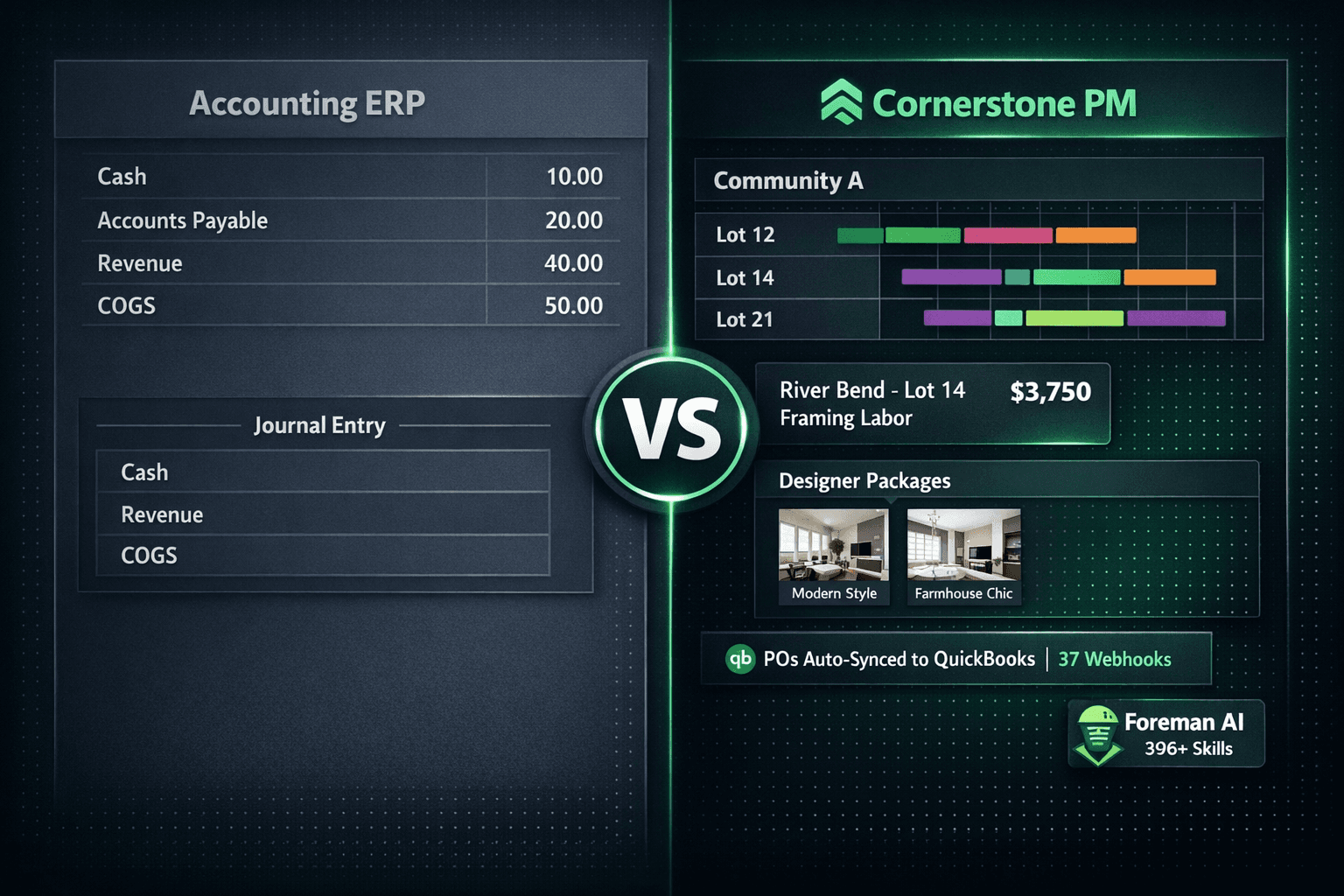
Premier Construction Software is a genuine accounting-first ERP built for commercial contractors who want to replace their general ledger — and for those firms, it is a fair choice. Production home builders are a different animal. They already run QuickBooks Online, build the same floorplans across communities, and need a buyer-facing design center far more than a new chart of accounts. Cornerstone PM connects to the books instead of replacing them, and it ships the production-builder stack that no ERP offers.
What Premier was built for — and who it serves well
Premier Construction Software has deep roots in commercial construction. Its core strength is the general ledger: full GL replacement, job costing tied directly to accounting, subcontract management with AIA billing, WIP schedules, payroll, and compliance reporting. For a commercial GC running a $50M hospital or a $200M school, that stack is genuinely valuable — the accounting complexity of those projects demands a platform where the books are the system, not a sidecar.
The problem is fit. A production home builder running 80 homes a year does not need AIA billing, WIP schedules, or general-ledger replacement. They need something Premier doesn't offer at all: a buyer-facing design center where the Magnolia plan's options are configured once and priced across every home in five communities, automated vendor bid templates scoped to trade, and an AI agent that can draft a punch list from a jobsite photo.
The fundamental model difference
Premier replaces your accounting system. Cornerstone connects to it.
That distinction shapes everything downstream. Builders who switch to Cornerstone keep the QuickBooks Online they already use for payroll, taxes, and banking — they just stop re-keying every PO and bill by hand. Cornerstone's one-way sync sends approved purchase orders, change orders, bills, and vendors to QuickBooks automatically, with each Community mapped to a QBO Customer and each Home to a Project for real per-home P&L without pivot tables or journal entries.
The sync is intentionally one-directional. Cornerstone is the source of truth. Changes made in QuickBooks — vendor address corrections, account reclassifications — never overwrite Cornerstone data. That separation protects the build record and means a superintendent never has to worry about their purchasing data shifting because a bookkeeper edited something.
What production home builders actually need
The production builder's workflow is built on repetition. The same Magnolia plan is sold to 40 buyers across three communities. The framing scope, electrical rough, and cabinet package are defined once and re-applied. The accounting system doesn't generate that leverage — the build platform does.
Design Center
64 curated Designer Packages across 7 categories auto-lock coordinated options when a buyer picks a style. Spec-level control goes down to the individual option — promote any standard finish to a paid upgrade with one setting change.
Blueprint AI Takeoff
Extracts 130+ material scopes from a floor plan PDF in under 60 seconds. Auto-quantity scope items tie paint, framing labor, and slab costs to Under Air Sqft or Total Sqft so every structural option reprices automatically.
Automated Vendor Bidding
One-click bid request sends scope-filtered Excel templates to vendors. Vendors submit through a no-login portal. Side-by-side comparison when 2+ submit. Community-assigned award locks the price.
Foreman AI — 396+ Skills
An agent that reads and writes your real data: edits options, generates purchase orders, builds area cost budgets by chat, creates punch lists from jobsite photos, and runs multi-step purchasing workflows — not just a chatbot that answers questions.
37 Webhook Events + REST API
Named webhook events with HMAC signatures and delivery logs across home lifecycle, scheduling, vendor notifications, and purchasing. 150+ REST API endpoints, each mapping to a Foreman skill. REST API and bring-your-own-agent access are Pro+ exclusive.
Side-by-side: Premier vs Cornerstone PM
Feature
Premier
Cornerstone PM
Core purpose
Replace the general ledger
Run the build; connect to QBO
Target buyer
Commercial GCs & developers
Production home builders 5–200 homes/yr
Accounting
Full GL replacement (native)
One-way sync to QuickBooks Online
Design center
None
64 Designer Packages, spec levels, exclusion groups
AI takeoff
None
Blueprint AI — 130+ scopes from a floor plan PDF
AI agent
None
Foreman AI — 396+ skills that take actions
Webhook events
ERP integration (consultant)
37 named webhook events, HMAC signed
REST API
Enterprise gated
150+ endpoints (Pro+ plan)
Implementation
Months, requires consultants
Days; AI migration wizard ~$0.01
Implementation: months versus days
Replacing an accounting system is a serious undertaking. Premier implementations are measured in months, typically involve dedicated implementation consultants, and require migrating or reconciling historical accounting data. For a commercial GC with decades of payables history and union payroll complexity, that effort is justified by the accounting capabilities they gain.
For a production home builder who already has QuickBooks, it's the wrong investment. Cornerstone's AI-powered migration wizard auto-detects the source platform — Buildertrend, JobTread, CoConstruct, or any CSV — and maps columns automatically for roughly a penny per migration. There is no general-ledger replacement because QuickBooks stays in place; Cornerstone just starts pushing clean, structured data into it from the day the connection is made.
Automation depth: gated vs. open
Full-ERP vendors typically gate integration work behind implementation consultants and custom connector fees. Builders who want a webhook when a purchase order is approved, or a REST API call that reads Foreman's skills from an external AI agent, are usually looking at a professional-services engagement.
Cornerstone ships that infrastructure out of the box. Thirty-seven named webhook events cover home lifecycle, scheduling changes, vendor notifications, cascade scheduling, messages, sales pipeline, and bid requests — each with typed payloads, HMAC signatures, and delivery logs with auto-retry. The Foreman AI agent exposes 396+ skills over a REST API where every endpoint maps one-to-one to a skill, plus a built-in MCP server so tools like Claude Desktop and Cursor connect directly to your build data without writing glue code. REST API and bring-your-own-agent access are Pro+ exclusive.
The honest split
Replacing your accounting system is a Premier conversation. Building the same plans repeatedly — and doing it with a design center, AI takeoff, vendor bidding, and a construction AI agent that actually takes actions — is a Cornerstone one.
Production home builders who have landed on Premier usually did so because they outgrew spreadsheets and heard “construction ERP.” The right question is whether they need to replace their books or supercharge their build. If QuickBooks Online is already working, the fastest path to margin clarity is connecting it to a platform built for how homes are actually built — not swapping the accounting engine underneath.
Cornerstone PM is purpose-built for the production home builder running 5 to 200 homes per year across one or more communities. It ships every module a production builder needs — design center, purchasing, scheduling, sales CRM, and AI agents — and connects to QuickBooks rather than competing with it.
Built for production home builders, not commercial ERPs.
Cornerstone PM connects to the QuickBooks you already use, ships a full production-builder stack, and gets your team operational in days — not months.
Request Early Access