A Weekly Production Meeting Agenda That Ends With Decisions, Not Status Updates
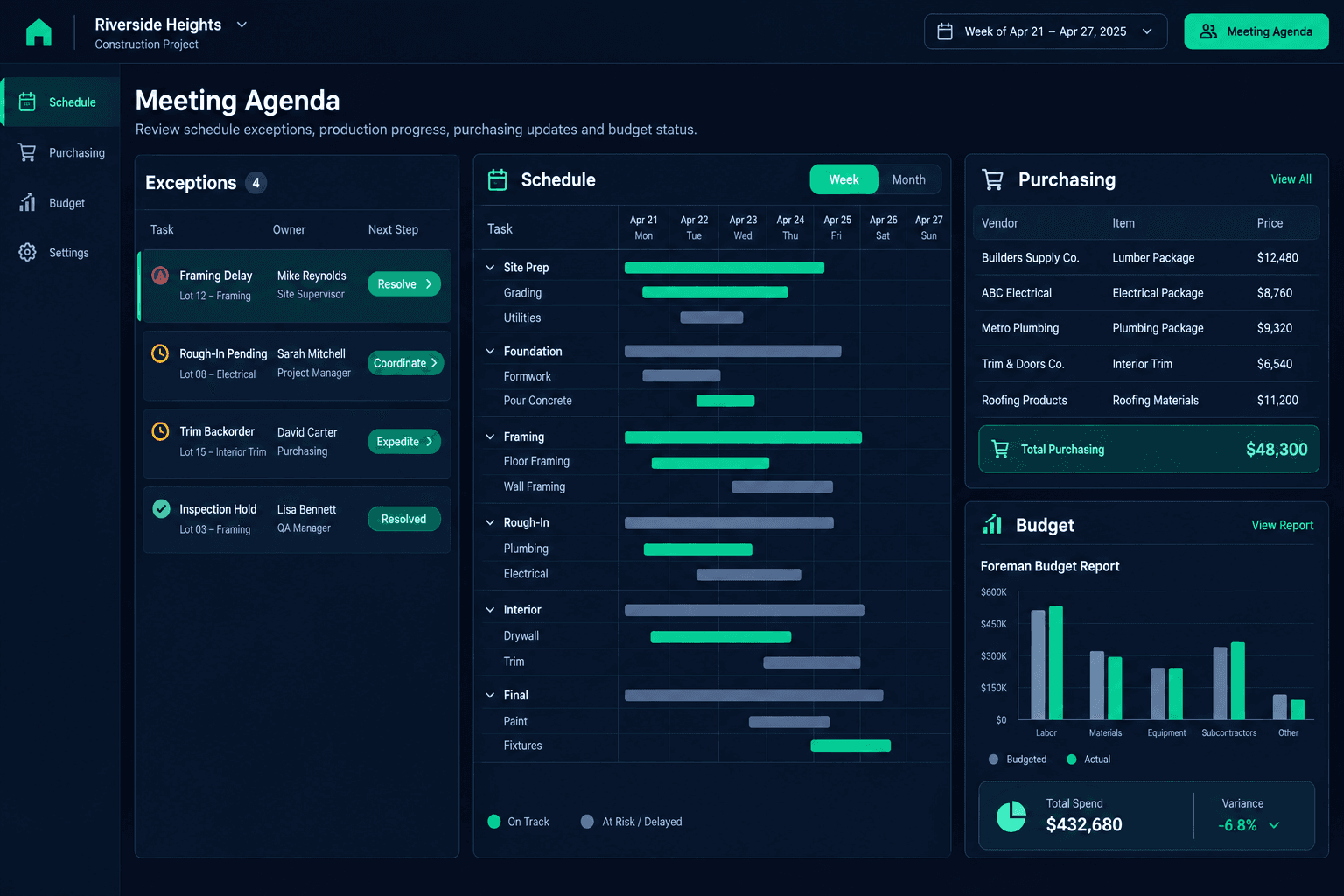
Run the weekly production meeting around exceptions, not a homes-by-homes status readout: pull every schedule delay, unpriced scope item, and budget variance into one list, and close the meeting with a named owner and a next step on every line. In Cornerstone, that list is already sitting in the linked schedule, purchasing, and budget records before anyone opens a laptop.
Why do production meetings turn into status readouts?
The default format is easy to fall into: go community by community, home by home, and ask "where are we?" on each one. It feels thorough, but most of the airtime goes to homes that are on schedule and need no discussion at all. The handful of homes with a real problem — a delayed trade, a vendor who never priced a change order, a budget creeping past committed cost — get the same few minutes as everything else, and the meeting ends with a list of things that were mentioned rather than a list of things that will change before next week.
An exception-first agenda inverts that. If a home has no schedule delay, no unpriced scope item, and no budget variance, it doesn't come up. The meeting only spends time on what actually needs a decision.
What belongs on the agenda?
Four categories cover most of what stalls a production schedule. Pulling all four from the same source data — rather than a spreadsheet someone updated manually the night before — is what keeps the list trustworthy.
Schedule exceptions
Tasks behind schedule and which trade they block downstream
Missing vendor pricing
Scope items with no accepted bid to purchase against
PO follow-ups
Purchase orders waiting on a vendor response or receipt
Budget variance
Lots trending over committed cost on the Foreman report
How do you frame a schedule delay so it leads to a decision?
State the downstream impact before the delay itself. Instead of "framing is running two days behind on Lot 12," say "framing is two days behind on Lot 12, and rough-in electric is scheduled to start Thursday — we have one day of slack before that start date moves." The second version tells everyone in the room exactly what decision needs to happen and by when. Cornerstone's linked home schedules and cascade scheduling carry that downstream relationship automatically, so the person running the meeting isn't reconstructing trade sequencing from memory mid-discussion.
Why do unpriced scope items belong in a production meeting?
A schedule task can show as on track and still be a problem if there is no accepted vendor bid behind it. Once that task completes, purchasing has nothing to generate a purchase order against, and the delay just moves one step downstream — from the schedule to the purchasing queue. Reviewing unpriced scope items in the same meeting as schedule exceptions catches the gap before it becomes a stalled PO the week after.
What to ask about every unpriced item
Has a bid been requested from a vendor for this scope item?
Is the task close enough to completion that pricing needs to be resolved this week?
Who is following up with the vendor, and by when?
How does budget variance fit into a weekly meeting?
Not every budget conversation needs a meeting, but a lot trending over its committed cost does. Pulling up the Foreman budget report for flagged lots during the same meeting — rather than in a separate monthly review — means the variance gets addressed while there's still time to change a decision, not after the home is already framed and the cost is locked in.
What makes an owner and next step "real"?
A real next step names a person and an action with a deadline: "Sarah calls the electrical vendor by Wednesday for the rough-in price" is real. "We'll keep an eye on it" is not. The test is whether the item could show up on next week's agenda with a clear answer to "what happened with this?" If the next step was vague, the answer is usually "nothing," and the exception repeats.
Does this replace meeting minutes?
The exception list itself is the output — annotated with an owner and next step next to each line — rather than a separate minutes document typed up afterward. Because the list is built from linked schedule, purchasing, and budget records rather than a static export, anyone can open it again before next week's meeting and see exactly what changed. Cornerstone doesn't generate automated meeting summaries or run the meeting itself — this is a recommended human workflow built on top of the same data your team already keeps current.
Frequently asked questions
How long should a weekly production meeting take?
Most builders running the agenda around exceptions instead of a full status readout keep it to 20-30 minutes, even across several communities. The length scales with the number of exceptions, not the number of homes under construction.
Does Cornerstone run or record the meeting automatically?
No. Cornerstone does not run automated meetings or generate meeting minutes. It surfaces the exception list, vendor pricing gaps, and budget variance from linked home schedules, purchasing records, and Foreman budget reports so the meeting itself stays a human conversation with real data in front of it.
Who should own the exception list during the meeting?
Typically the production manager or superintendent running the meeting owns reading the list, but each individual exception gets assigned to whoever is closest to resolving it — a superintendent for a schedule delay, a purchasing coordinator for missing vendor pricing.
What if an exception has no clear owner yet?
Assign an owner anyway, even if their first next step is just to investigate and report back next week. An exception without a named owner is the most common reason the same delay shows up on the agenda three weeks in a row.
Walk into next week's meeting with the exception list already built.
Schedule delays, unpriced scope items, and budget variance — pulled from linked home schedules, purchasing, and Foreman budget reports, available on every Cornerstone plan.
Request Early Access