It’s Not a Chatbot, It’s an Agent: AI That Actually Runs Your Build
Most construction AI just answers questions. Foreman reads and writes your live Cornerstone PM data—editing design options, updating vendor pricing, and running multi-step purchasing workflows on your behalf. That’s the difference between a chatbot and an agent.
The construction software market has a habit of calling anything with a text box an “AI assistant.” A feature that surfaces your next-due task is not an AI agent. A search box that auto-completes a vendor name is not an AI agent. An AI agent takes real actions inside your system—reads your actual data, makes changes, and confirms what it did. Foreman AI does that across 396+ skills built specifically for home building workflows.
What does “reads and writes your data” actually mean?
The most important distinction in construction AI right now is between tools that retrieve information and tools that can change it. Retrieval is useful—being able to ask “which vendor won the framing bid on the Magnolia plan?” and get a real answer is better than digging through a report. But the bigger operational opportunity is acting on that answer: updating the scope, sending the PO, flagging the discrepancy.
Foreman AI is wired directly to your Cornerstone PM account. When you ask it to update a design option price, it updates the design option price. When you ask it to generate a bid template for a new community, it pulls your current scope items and vendor assignments and produces the template. When it runs a profitability report, it reads your live build data—not a stale export from last Thursday.
This read-and-write access is what the Foreman AI page calls agent-first design. Most software companies retrofitted AI onto existing products after the fact. Cornerstone was built to be AI-agent-native from the start.
What can Foreman actually do?
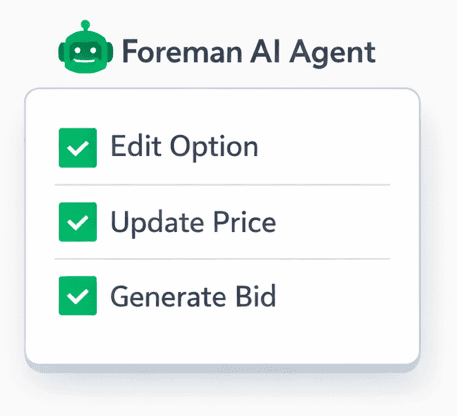
Foreman AI has 396+ skills across 20 construction categories. Here are the action categories builders use most:
Edit design options
Update option names, spec levels, prices, product images, and descriptions across multiple floorplans in a single instruction.
Generate bid templates and SOW documents
Foreman pulls your scope items and vendor assignments and produces a structured bid template or scope-of-work document — ready to send.
Run purchasing workflows
Reprice a floorplan after a vendor update, flag options missing vendor pricing, or walk through a full bid-to-PO flow — step by step, in the app.
Attach product images from supplier sites
Give Foreman a product name or model number. It searches the supplier page, saves the image to permanent hosted storage, and attaches it to the design option. No broken links.
Score vendors and surface profitability data
Foreman compares vendor bids, generates vendor scorecards, and runs profitability and budget reports from live build data — in seconds, not spreadsheet-hours.
Every one of these is a real write operation into your Cornerstone PM account —not a suggested next step, not a copy-pasteable template you fill in yourself. Foreman completes the action and reports back what it changed.
How does Foreman compare to AI features in Buildertrend, JobTread, and CoConstruct?
Buildertrend, JobTread, and CoConstruct all have AI features. They share a common pattern: they summarize, suggest, or surface. They answer questions about your data. They don’t edit the data. The distinction matters operationally: a tool that tells you your bid is missing a line item is helpful; a tool that adds the line item for you is a different category of capability.
Beyond the read-vs-write gap, there’s the domain depth gap. Foreman runs on a 24,500-word construction knowledge base, 39 estimating formulas, and a skill catalog built specifically for residential production building—floorplan-level option pricing, Structural vs. Designer scope separation, community-assigned vendor wins, and more. Generic AI tools that sit on top of a construction database don’t carry that domain layer. They answer from the data; Foreman answers from the data plus construction expertise.
None of the major competitors have a skill catalog remotely close to 396+. Most have a handful of pre-built queries or a single summarization endpoint.
Foreman learns your business, not just your commands
The agent capabilities compound over time because Foreman maintains two memory layers. Per-user memory stores your name, role, preferred vendors, and communication style. Company-wide memory builds vendor scorecards, captures recurring scope patterns, and holds builder-level defaults. Together they mean Foreman isn’t starting from zero every time you open a session.
Practical examples: a superintendent who always orders plumbing fixtures from Ferguson doesn’t need to specify Ferguson every time. A purchasing manager who runs the Magnolia plan 40 times a year doesn’t re-explain what the Magnolia plan is. An owner who wants concise responses gets concise responses without coaching it every session.
For more on how Foreman’s memory system works, see the Foreman AI Memory deep-dive. For how it keeps working through marathon sessions, see why most construction AI forgets—and how Foreman doesn’t.
The 396+ skill catalog: what’s actually in it?
The 396+ skill count isn’t a marketing number padded with trivial queries. The skills span 20 categories and map to real purchasing, design, scheduling, and reporting workflows:
Each skill connects to your live data. When Foreman generates a SOW document, it pulls your actual scope items. When it runs a profitability report, it reads your real bid numbers. The skill catalog isn’t running on examples—it’s running on your build.
Foreman is a Pro+ capability—here’s why that matters for ROI
Foreman AI is available on the Pro+ plan at $599/month. Pro+ is the plan that also includes the REST API and BYOA (Bring Your Own Agent access), making it the right tier for builders who want the full platform and the full automation layer.
The ROI case is straightforward: if Foreman saves a purchasing manager two hours a week on option updates, bid template generation, and vendor lookups, it pays for itself in a month. If it catches a mispriced scope item before it goes to the homebuyer, it pays for itself in a day.
For builders who want to connect external AI tools like Claude Desktop, Cursor, or Windsurf directly to their Cornerstone PM data, the built-in MCP server exposes the full Foreman skill catalog to those tools as well.
“The difference between a chatbot and an agent is the difference between advice and work. Foreman edits the design option, updates the vendor price, and generates the bid template. You review and approve. That’s a fundamentally different relationship with software than asking a question and manually doing what it tells you.”
Ready for AI that actually does the work?
Foreman AI reads and writes your live construction data across 396+ skills. Available on Pro+ as part of Cornerstone PM.
Request Early Access