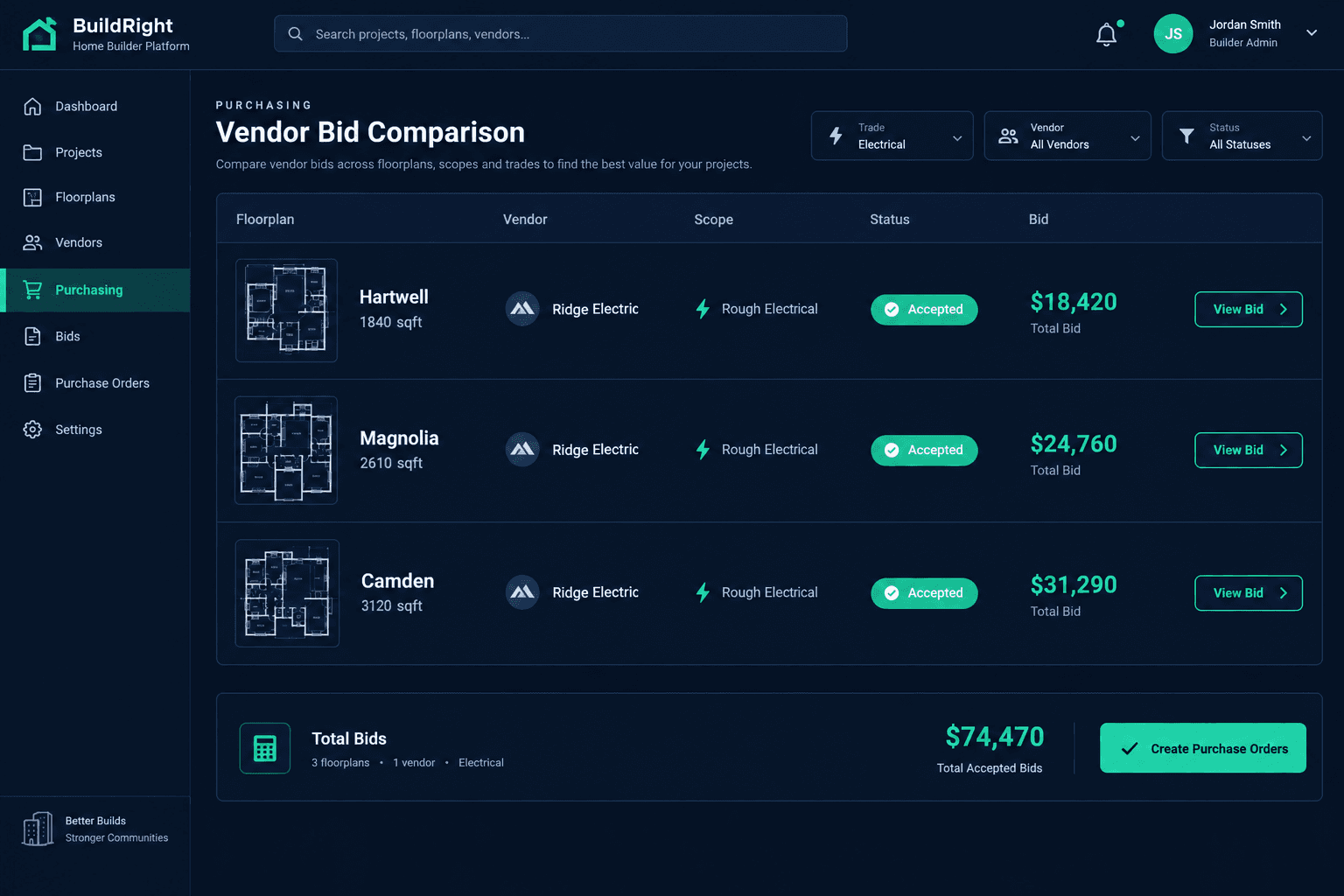
Same Trade, Different Floorplans: Compare the Bid Plan by Plan
Comparing a vendor's bid by floorplan — not by averaging it into a single whole-house number — shows whether their pricing actually scales with the home, so each floorplan's budget reflects the scope it actually requires.
Most builders compare vendor pricing the same way they compare two restaurants: one number per vendor. That works fine when a scope item genuinely doesn't change across homes — a flat-rate permit pickup fee, say. It breaks down the moment a trade's labor or material actually depends on the floorplan: rough electrical in a 1,800 sqft plan is not the same job as rough electrical in a 3,200 sqft plan, and a vendor's bid should say so.
A single blended number hides that difference. It can overcharge the smaller plan to subsidize the larger one, or undercharge the larger plan and quietly erode margin on every one you build. The fix isn't a new pricing model — it's comparing the same vendor's accepted pricing across the floorplans it applies to, instead of accepting one number and assuming it holds everywhere.
Why compare the same vendor across floorplans instead of across competitors?
Side-by-side bid leveling answers a different question than the one here. Leveling lines up two or more vendors against the same scope to decide who wins the work. Once a vendor is awarded, a separate check is worth running: does that vendor's accepted price make sense across every floorplan it applies to, or does it look like one number got applied everywhere without adjustment?
Picture three plans — the Hartwell at 1,840 sqft, the Magnolia at 2,610 sqft, and the Camden at 3,120 sqft — all using the same awarded electrical vendor. Reviewing the accepted scope item pricing plan by plan surfaces whether the Camden's number actually reflects the extra runs and panel capacity a larger home needs, or whether it was copied from the Hartwell's bid without a second look.
Rough Electrical — Accepted Pricing by Floorplan
The Hartwell — 1,840 sqft
Ridge Electric · Rough Electrical
The Magnolia — 2,610 sqft
Ridge Electric · Rough Electrical
The Camden — 3,120 sqft
Ridge Electric · Rough Electrical
Hypothetical example — reviewing one vendor's accepted scope item pricing across the floorplans it's attached to.
How is this different from catalog part pricing?
It's worth being precise here, because the two concepts sound similar and aren't. A stocked part's unit price — a specific light fixture, a specific sheet good — comes from the global parts catalog and doesn't change because a different floorplan is selected. The part costs what it costs regardless of which home it goes in.
What does change by floorplan is quantity and labor: how many outlets a plan needs, how many linear feet of duct a layout requires, how many hours a trade spends on a 3,120 sqft house versus an 1,840 sqft one. Per-floorplan scope item pricing is about that relationship — the accepted bid price tied to a scope item for a specific plan — not about the catalog part itself changing value. Keeping that distinction clear matters when reviewing a vendor's bid: a flat per-home number for a scope item that should scale with square footage is the thing worth questioning, not the catalog part prices underneath it.
What should a builder look for in a vendor's bid before accepting it?
Two patterns are worth flagging before a bid gets accepted. The first is a flat per-home allowance that doesn't move at all between the smallest and largest floorplan a builder runs — that's a sign the vendor priced “a house” in the abstract rather than the specific plans in front of them. The second is a quote that never names a floorplan at all, just a trade and a total. Either one is reasonable grounds to ask the vendor to break pricing out plan by plan before awarding the scope.
This isn't about distrusting vendors — most are glad to provide plan-level numbers once asked, because it protects their own margin on the larger plans as much as it protects the builder's budget on the smaller ones. It's a five-minute question that prevents months of a blended number quietly distorting every budget built from that vendor's pricing.
Don't assume a quiet default
If a vendor's bid is silent on floorplan, treat the number as a starting point for a conversation — not as an implicit answer. Inventing a default scaling factor to fill the gap introduces an assumption nobody actually agreed to. The accurate move is to ask the vendor directly.
How does accepted pricing follow the floorplan afterward?
Once purchasing accepts a vendor's scope item pricing for a given floorplan, that number is what feeds every home built from that plan in the community — nobody re-keys the electrical line for the fortieth Magnolia built on the same street. The accepted price is the one that flows into the budget, consistent with the hard cost rule that every budget line traces back to real, accepted vendor pricing rather than an estimator's placeholder.
That's the payoff of doing the floorplan-level review before acceptance instead of after: the accuracy of that one review compounds across every home of that plan a builder sells, instead of a single overlooked number quietly repeating itself across dozens of budgets.
Compare bids the way your floorplans actually differ.
Cornerstone PM keeps accepted vendor pricing tied to the floorplan it belongs to, so a review catches a mismatched number before it repeats across every home of that plan.
Request Early Access