Why Lowest-Bid Auctions Hurt Home Builders (and What We Do Instead)
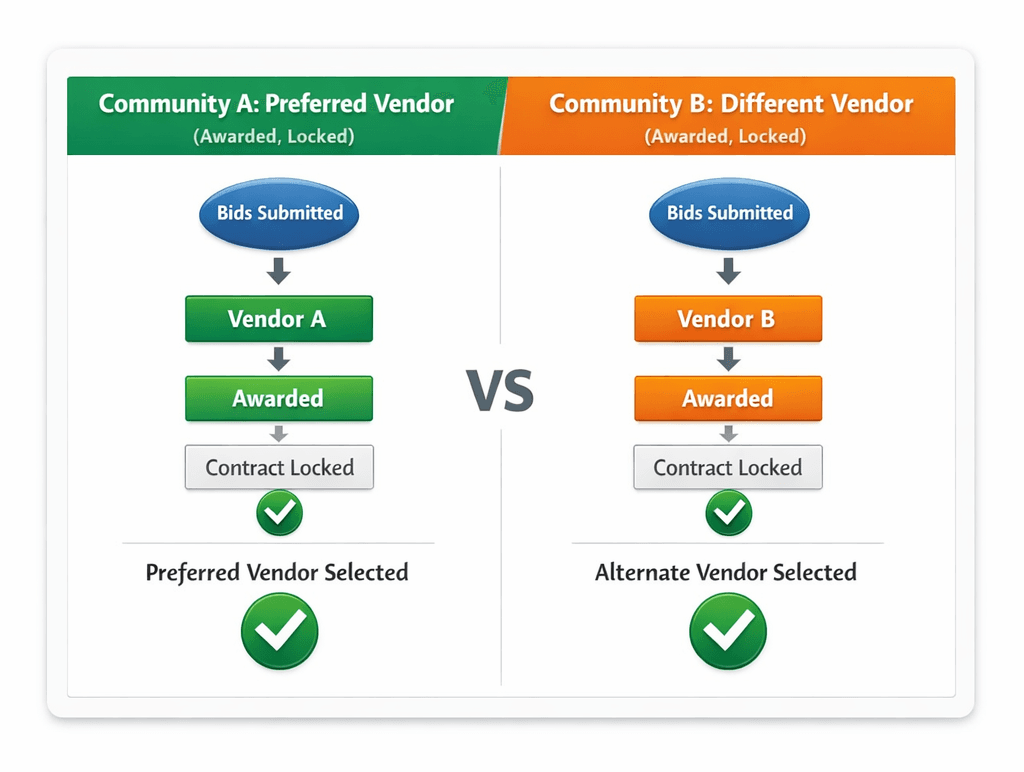
Cornerstone PM lets builders award vendor bids by community — not just by lowest price. One vendor wins Community A, a different vendor wins Community B. Once a bid is accepted, it locks: no silent revisions, no invoice creep, no margin erosion after the fact.
Most bid management software is built around a simple idea: collect bids, pick the lowest number, move on. That logic works fine on commodity materials. It breaks badly when applied to the subcontractor relationships that actually keep production schedules running. Cornerstone PM's purchasing system was built around a different premise: the builder — not an algorithm — decides who wins.
Why does lowest-bid logic fail for home builders?
A production builder isn't running a one-time government contract. The same framing crew, the same plumbing sub, the same finish carpenter shows up to every home in a community — sometimes for years. The quality of that relationship, and the sub's familiarity with your standards and schedule, is real economic value that doesn't appear in a bid spreadsheet.
Relationships don't survive a race to zero
Your best framing contractor has held your schedule for three seasons. A newcomer undercuts them by 4% on paper. The auction says switch. Then the newcomer misses the first two starts and your schedule collapses. The cheapest bid is never just about the number.
One vendor can't serve every community equally
A plumbing sub based in the north end of your metro runs faster, tighter schedules in those communities. A different sub covers the south. Forcing a single lowest-bid winner across all communities ignores travel time, crew capacity, and on-site familiarity.
Vendors game the auction on re-bid
When vendors know they'll be bid against every round, they come in low to win — then recover margin on change orders, substitutions, and schedule delays that are technically their fault but hard to prove. Trusted vendors with locked pricing don't play that game.
Post-award edits create silent margin erosion
Without a locking mechanism, awarded prices drift. A vendor sends a revised invoice 'reflecting updated material costs.' A project manager accepts it without escalating. The Master Cost Budget never gets updated. By the time the home closes, the margin is gone and nobody knows why.
Scale any of these across 80 homes a year in four communities and the real cost of lowest-bid logic becomes visible: schedule variance, quality callbacks, and margin bleed on change orders that wouldn't exist with trusted vendors locked to confirmed pricing.
How does Cornerstone PM handle vendor bid awards differently?
The bid award in Cornerstone PM is a builder decision — informed by side-by-side bid comparison, but not forced by it. Here's how the flow works:
- Send scope-filtered bid requests. Select the floorplans, vendors, scopes, deadline, and message from the Purchasing → Bid Requests flow. Each vendor gets an Excel template with only their trade's scope — no cross-scope clutter.
- Vendors submit through a no-login portal. A token-protected link in the bid request email takes vendors straight to a portal where they can download the template, upload their pricing, and submit — no account creation required.
- Compare bids side by side. When two or more vendors submit on the same scope, the comparison view puts them next to each other. You see the numbers, the per-unit rates, and any notes the vendor added. Price is one input, not the only one.
- Award by community. Vendor A wins Community A. Vendor B wins Community B. You can hold multiple accepted bids per scope — the same framing sub might cover three communities while a specialist handles your fourth. The platform follows your decision, not a pricing algorithm.
- The bid locks on acceptance. Once you award a bid, it locks. Neither builder nor vendor can quietly edit the number. If real conditions change and a revision is warranted, it goes through a formal change process — not a silent invoice update that nobody catches until reconciliation.
What does "locked" actually mean for your budget?
A locked bid in Cornerstone PM means the awarded number flows into the Master Cost Budget as confirmed pricing. It doesn't change unless you explicitly approve a change order through the system. That matters because:
- Your cost model stays accurate. When you're pricing homes in a new community, the confirmed vendor bids from a prior community give you a real cost baseline — not an estimate that might drift.
- Margin erosion surfaces immediately. If a real change is needed, the system shows the delta against the locked bid. You can see exactly how much the variance is costing before you approve it.
- Vendors know the rules. When vendors know the bid locks on acceptance, they submit real numbers — not low bids they intend to recover through change orders. The bidding process becomes honest because the lock makes it count.
Community-assigned awards: a practical example
You're running three communities simultaneously — Oakridge (north), Creekside (central), and River Bend (south). You send framing bid requests to four subs. Here's what the award looks like in Cornerstone PM:
Peak Framing wins two communities because they're well-established up north and the schedule relationship is strong. Southside Frames wins River Bend because their crew is already in that corridor on another project and their pricing reflects lower travel cost. Both bids are locked. The Master Cost Budget reflects confirmed framing costs for all three communities — not estimates.
Bid management feature comparison
Vendor bid management: Cornerstone PM vs. typical construction software
How vendor bid awards fit the full purchasing workflow
The bid award isn't a standalone feature — it's the confirmation step in Cornerstone PM's end-to-end purchasing system for production home builders. Here's where it sits in the full flow:
- Blueprint AI extracts 130+ material scopes from a floor plan PDF in under 60 seconds
- Auto-quantity scope items and allowances populate the Master Cost Budget before any bids arrive
- Scoped bid requests go out with auto-generated Excel templates — each vendor sees only their trade
- Vendors submit through the no-login portal; the bid locks when they submit
- Side-by-side comparison informs the award — you pick the vendor, not the lowest-price algorithm
- Awarded bids lock and flow into the Master Cost Budget as confirmed pricing, replacing any allowance placeholder for that scope
- Bid Import AI handles re-imports when scope or pricing changes — replacement, not duplication
The result is a purchasing system where every confirmed dollar traces to a real vendor, a real scope, and a real award — per community, per floorplan, with nothing that can be quietly revised after the fact.
Award by relationship. Lock on acceptance. Protect your margin.
Cornerstone PM's vendor bid system gives builders the control to assign the right vendor to the right community — and lock the pricing the moment it's accepted. No auction race, no silent revisions, no surprises at reconciliation.
Request Early Access