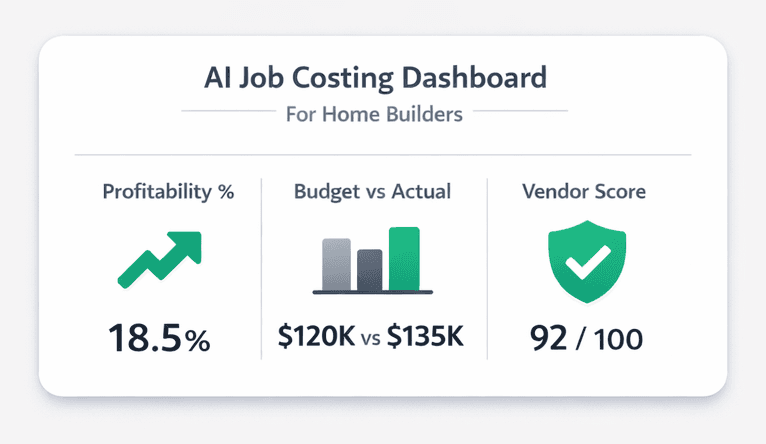
AI Job Costing: Profitability Reports and Vendor Scorecards on Demand
Foreman AI generates profitability reports, budget reports, vendor scorecards, and bid comparisons from your live Cornerstone PM data in seconds — because it reads and writes your real records, not a stale export. Stop building margin reports by hand.
Most production home builders run job costing the same way: pull a budget export at month-end, paste it into a spreadsheet, manually add actual costs from the accounting system, build pivot tables, and email a PDF to whoever asked for it. By the time the report lands in an inbox, the underlying data has already moved. The framing sub submitted a revised bid. A vendor got awarded on a new community. An allowance got replaced by a real price.
The problem isn't the spreadsheet skill. It's that the data lives in your construction platform but the analysis has to happen somewhere else. Foreman AI closes that gap: because it's directly wired to your live Master Cost Budget, it can generate any report you need in a single prompt — no export, no pivot table, no waiting.
What reports can Foreman generate on demand?
Profitability reports
Foreman calculates gross margin per home or per community from your live Master Cost Budget and awarded vendor bids — no export, no spreadsheet, no waiting on the accountant.
Budget reports
Budget vs. actual breakdowns at the scope level, across a single floorplan or rolled up to a community. Foreman pulls from the same data your purchasing team works in daily.
Vendor scorecards
Foreman compares submitted bids, on-time performance patterns, and awarded history across vendors to score each one. Know which subs are pricing fairly and which are slipping before the next bid cycle.
Bid comparisons and SOW documents
When two or more vendors bid the same scope, Foreman lays them side by side and surfaces the delta. It can also generate scope-of-work documents from your existing scope items — ready to attach to a bid request.
Each of these pulls from your live Cornerstone PM records — the same vendor bids your purchasing team is working with today, the same Blueprint AI takeoff quantities, the same awarded pricing that locked when you accepted a bid. The reports aren't extrapolations or estimates. They're summaries of the data your platform is already tracking.
Why does live data access change what AI can do?
Generic AI tools — ChatGPT, Claude used as a standalone assistant — answer from training data. They can tell you what a profitability report should look like, but they have no idea what your Magnolia plan's framing scope cost, which vendor won Community B, or whether your paint contractor is pricing 12% above benchmark.
Foreman's read-and-write access to your account is what makes the difference. Foreman is an agent, not a chatbot: it doesn't just describe what to look at, it goes and looks. A prompt like “show me profitability across Community A broken down by scope” returns an actual answer using your actual numbers — not a template you fill in yourself.
That live connection also means the report is always current. Ask on Monday, ask again Friday after three more bids close, and you'll get two different answers — both accurate to that moment.
How vendor scorecards work in practice
Most builders maintain vendor relationships informally: you know which framer you trust, which plumber prices aggressively, which HVAC sub tends to pad estimates. That institutional knowledge usually lives in the estimator's head — and walks out the door when they leave.
Foreman can make that knowledge explicit. By reading your historical bid data and awarded history inside Cornerstone PM, it can surface patterns: which vendors are consistently within 5% of the winning bid, which ones price 20% over benchmark and never get awarded but keep submitting, which ones have won on multiple communities and delivered reliable pricing.
The output is a vendor scorecard per trade — a structured summary you can share with a project manager, use to prequalify vendors on a new community, or reference when a sub asks why they weren't awarded. It takes a single Foreman prompt. The alternative is an afternoon in Excel.
How this fits into the full purchasing system
Foreman's reporting skills sit at the end of a purchasing chain that starts with real data:
- Blueprint AI takeoff extracts real material quantities from your floor plan PDF — not estimator guesses
- Auto-quantity scope items calculate sqft-driven costs across every floorplan and structural option automatically
- Vendor bid requests go out with scope-filtered Excel templates; vendors submit through a no-login portal
- Awarded bids lock and flow into the Master Cost Budget — no filler, no synthetic splits, every dollar traced to a real vendor and a real scope
- Foreman reads that clean, real budget and generates profitability reports, vendor scorecards, and bid comparisons in seconds from live data
The reporting is only as good as the data underneath it. Because Cornerstone PM removed filler pricing app-wide, every number Foreman summarizes traces back to a real source. A profitability report from filler data is still a guess dressed up in a table. A profitability report from real vendor bids and real takeoff quantities is a number you can act on.
What about long reports and multi-step analysis?
One risk with AI reporting tools is that the AI loses context mid-task — it starts a profitability summary across 12 floorplans and forgets the framing scope three plans in. Foreman's built-in memory compaction handles long sessions by intelligently summarizing older context as it goes. Combined with the per-user memory that carries your name, role, and preferences across every conversation, Foreman stays sharp through analysis runs that would exhaust a standard AI tool.
The context health meter (green / yellow / red) lets you see at a glance how much working memory the session has consumed, so you can start a fresh session before you hit a degradation point — not after.
Foreman AI and the 396+ skill catalog
Profitability reports, vendor scorecards, and budget analysis are part of a 396+ skill catalog that Foreman draws on across 20 construction categories. The same agent that generates a vendor scorecard can also edit design options, update vendor pricing, generate bid templates, attach product images, and run multi-step purchasing workflows.
Every time Cornerstone PM ships a new Foreman skill, it's immediately available — in the app, through the MCP server for Claude Desktop and Cursor users, and through the REST API for Pro+ subscribers building their own integrations. The skill catalog grows; your access to it doesn't require any configuration change.
Frequently asked questions about AI job costing
Frequently Asked Questions
What is AI job costing software for home builders?
How does Foreman generate profitability reports from live data?
What is a vendor scorecard and how does Foreman build one?
Can Foreman compare multiple vendor bids side by side?
What plan includes Foreman AI reporting?
How is this different from just exporting a spreadsheet?
Can Foreman generate a scope-of-work document automatically?
Stop building margin reports by hand.
Foreman AI generates profitability reports, vendor scorecards, and budget summaries from your live build data — in seconds, not spreadsheet-hours. Available on Pro+.
Request Early Access